Our focused & intentional approach

Most pricing problems are not price problems. They are strategy, capability, and execution problems. Our approach works across all four layers: the foundation that grounds every decision, the levers that move margin, the capability that makes change stick, and the journey that gets you there.

How we work

Lasting pricing improvement requires strategy, tools, and execution working together. We work across all three phases, customized to your business.

What we move


Strategy sets the direction. The levers are where you act on it. Most organizations are only managing one or two. We examine all four, focusing on what will have the highest impact for your business.

What you charge in principle

Architecture, level, optimization, governance, and cadence all shape what you ultimately charge. Price is the lever with the highest direct impact on margin. A 1% improvement in realized price typically delivers 3–5× more margin impact than a 1% reduction in variable costs.

What we examine

  • Price Architecture: tiers, modules, usage-based, good-better-best, pack structures.
  • Price Level Optimization: elasticity, WTP research, competitive positioning, corridors.
  • Price Governance & Cadence: who owns it, how often reviewed, what triggers a change.

What you concede in the moment

Discounting is where pricing strategy most often breaks down. The gap between list price and realized price is a direct measure of commercial discipline — and most organizations have more room here than they realize.

What we examine

  • Policy & Authority: thresholds, approval rights, floor prices, escalation paths
  • Mechanics & Types: volume, promotional, loyalty, contractual, off-invoice
  • Effectiveness & ROI:  discount rate analysis, margin impact, behavior attribution

What you commit to structurally

Payment terms, volume commitments, and contract architecture define the structural conditions under which pricing operates. Getting these right locks in value and creates the conditions for consistent margin performance.

What we examine

  • Price Governance Clauses: escalation rights, indexation, price protection limits.
  • Volume Commitments: minimums, tiered incentives, rebate structures, true-ups.
  • Contract Architecture: term length, renewal conditions, flexibility provisions

What you choose to grow

Which products, customers, and channels you prioritize determines your revenue quality. Mix management is often the fastest path to margin improvement — without changing a single price.

What we examine

  • Product Mix: SKU rationalization, format shifts, tier and bundle prioritization
  • Customer Mix: segment profitability, vertical focus, account targeting
  • Channel & Offer Mix: channel margin, bundle design, offer configuration

What you charge in principle

Architecture, level, optimization, governance, and cadence all shape what you ultimately charge. Price is the lever with the highest direct impact on margin. A 1% improvement in realized price typically delivers 3–5× more margin impact than a 1% reduction in variable costs.

Sub-dimensions:

  • Price Architecture: tiers, modules, usage-based, good-better-best, pack structures
  • Price Level Optimization: elasticity, WTP research, competitive positioning, corridors
  • Price Governance & Cadence: who owns it, how often reviewed, what triggers a change

Industry applications:

  • Consumer Goods > Pack architecture, price-pack curves, promotional price points
  • Manufacturing and Distribution > Configured pricing, surcharges, cost-plus structures
  • Software and Technology > Tiered seats, usage-based, module pricing
  • Business Services > Rate cards, project vs. retainer, value-based fees

Duis et ligula sem. In hac habitasse platea dictumst.

Maecenas aliquet lorem a orci consequat auctor. Proin non dui eu nibh tincidunt imperdiet sit amet quis ligula.

Lorem ipsum dolor sit amet, consectetur adipiscing elit. Aenean porttitor scelerisque erat vitae laoreet.

Duis et ligula sem. In hac habitasse platea dictumst.

Maecenas aliquet lorem a orci consequat auctor. Proin non dui eu nibh tincidunt imperdiet sit amet quis ligula.

Lorem ipsum dolor sit amet, consectetur adipiscing elit. Aenean porttitor scelerisque erat vitae laoreet.

Duis et ligula sem. In hac habitasse platea dictumst.

Maecenas aliquet lorem a orci consequat auctor. Proin non dui eu nibh tincidunt imperdiet sit amet quis ligula.

What makes levers stick

Clean, harmonized, trusted pricing data

The single precondition for everything else. 
Without it, even great strategy produces confidently wrong answers.

Technology encodes strategy and makes decisions scalable

from Excel MVPs to production platforms to embedded decisioning in CPQ and ERP.

Owns pricing decisions and how they get made and enforced

Decision rights, escalation paths, pricing forums, and the cadence that prevents drift.

Skills, behaviors, workflows, and routines.

Pricing excellence requires that the right people know what to do, have the tools to do it, and operate in a process that makes good decisions.

Skills, behaviors, workflows, and routines.

Pricing excellence requires that the right people know what to do, have the tools to do it, and operate in a process that makes good decisions.

How every recommendation is made

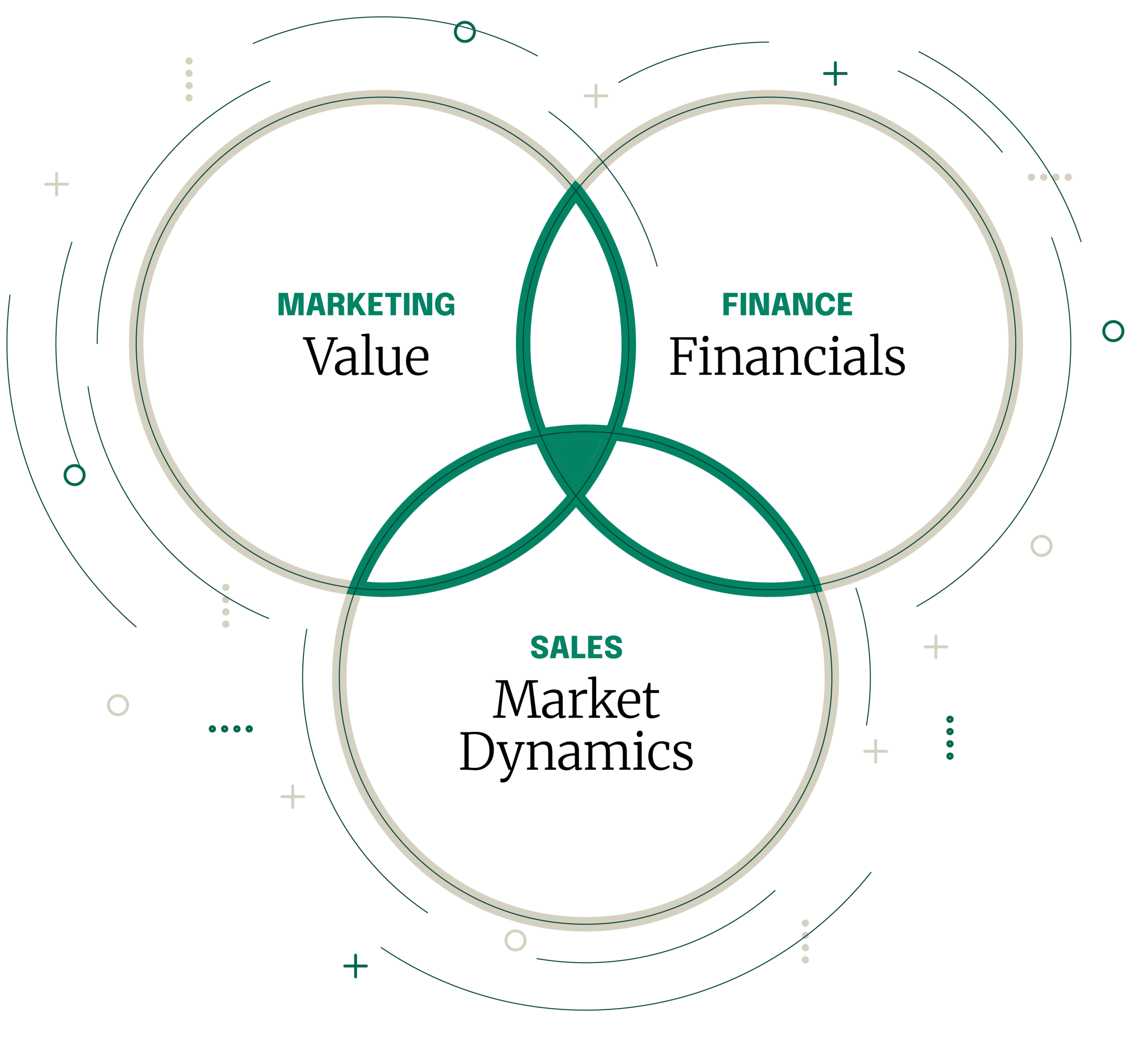
Effective pricing sits at the intersection of three interlocking forces: Market Conditions, Financials and Value.

Value: reflects what customers are truly willing to pay based on their needs and perceived differentiation.

Financials: define the economic reality of the business, margins, costs, and where profit is created.

Market conditions: represent the external environment, including competitors, channels, and macro signals.