In the modern SaaS landscape, growth is not just about building a great product or hiring more sales reps. How you go to market, whether through a self-serve, product-led motion or a traditional, sales-led approach, fundamentally shapes your unit economics, scalability, customer experience, and long-term competitiveness.
Too many companies treat their go-to-market (GTM) motion as a legacy decision rather than a strategic choice. As their product, market, or ambitions evolve, that choice often becomes outdated, or even counter-productive.
This article provides a clear framework to help executives decide between a Product-Led Growth (PLG) or Sales-Led Growth (SLG) model and, if needed, transition from one to the other or adopt a hybrid.
Table of Contents
What Is Product-Led Growth (PLG)?
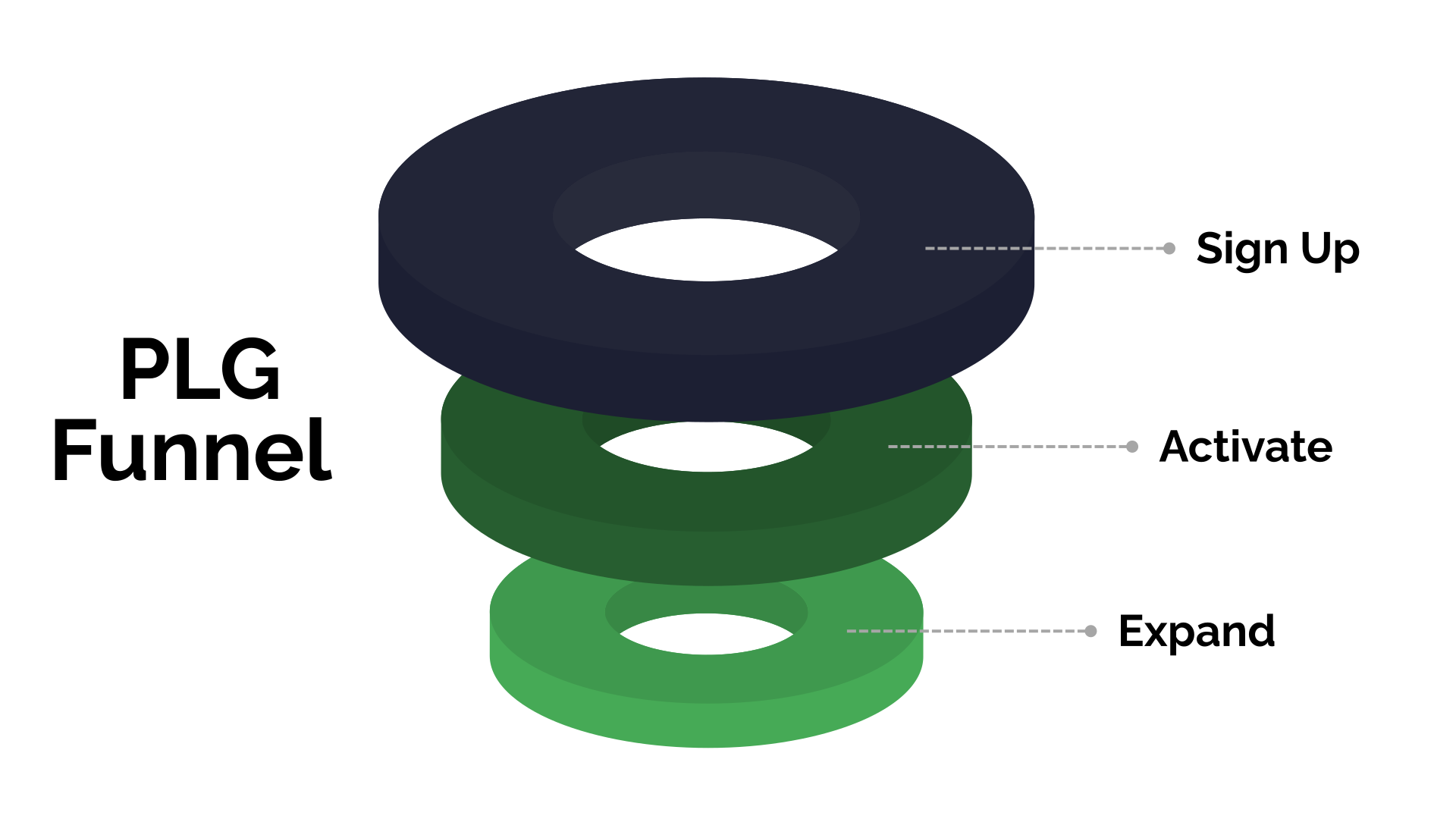
Product-Led Growth is a GTM strategy where the product itself becomes the primary engine for acquisition, activation, conversion, and expansion. In a PLG company, users can discover, try, adopt, and pay for the software with minimal human intervention.
Core characteristics of PLG include:
- Self-service onboarding: Users can sign up, start using the product, and realize value quickly without sales interaction.
- Transparent, usage- or value-aligned pricing: Pricing is simple, often modular or usage-based, enabling small teams or individuals to begin paying as soon as they derive value.
- Bottom-up and viral adoption: Individual users, often developers or front-line staff, drive adoption internally and potentially pull their organizations in.
- Built-in expansion motion: As users engage more deeply or consume more resources, they naturally upgrade, expand usage, or slap on add-ons, without a sales handoff.
Companies such as Calendly, Dropbox, Slack, and Canva demonstrate how a well-designed product can acquire, activate, and expand users with minimal sales involvement
When well executed, PLG enables rapid scaling with relatively low Customer Acquisition Cost (CAC) and lean sales/marketing overhead. For many modern SaaS products, especially those targeting SMBs or teams, PLG has become the preferred GTM model.
Key Differences in One View
Here is a distilled comparison of PLG and SLG across critical dimensions:
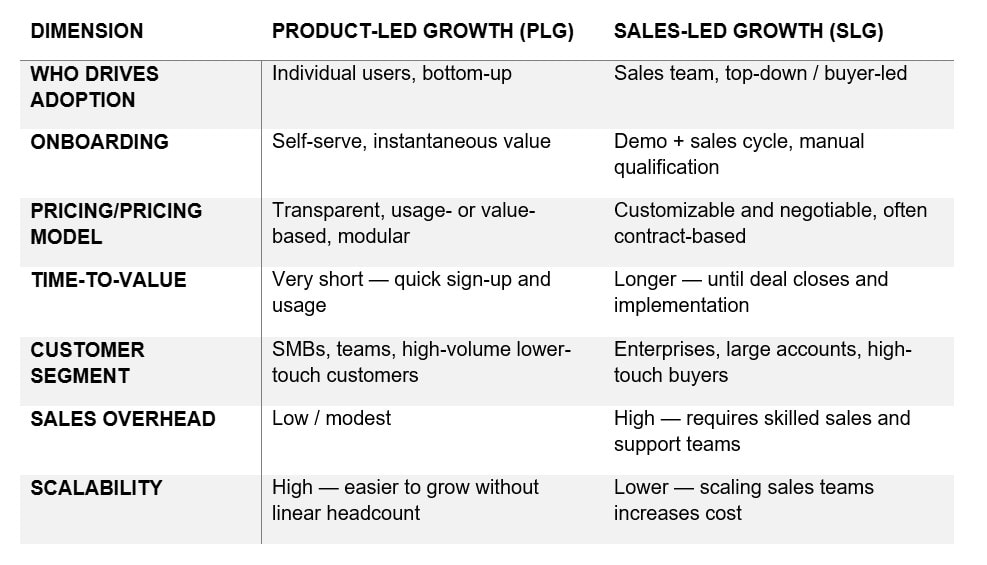
This contrast is not theoretical, it represents two fundamentally different ambitions, operating models, cost structures, and organizational designs.
What Is Sales-Led Growth (SLG)?
Leaders should watch for simple but telling signs that pricing is underperforming. If any of the following apply to your business, it is likely time to reevaluate your pricing strategy:
- Win rates look acceptable only when discounts are applied, but collapse when pricing is at target
- Prospective customers say that tiers or plans “do not make sense.”
- Significant features, especially major new ones such as AI or modules are included at no extra cost
- Custom or one-off deals are common
- Pricing has not changed meaningfully in two or more years despite product evolution or market shifts
- These indicators often signal that pricing is not treated as a strategic lever but rather as a checkbox exercise, locked in place by inertia or fear of friction
When to Use Product-Led vs. Sales-Led (and When Not)
Favor PLG When:
- The product delivers value quickly, and users can adopt independently.
- Your target buyer is a small team, an individual contributor, or someone who prefers self-serve.
- You aim for low CAC, rapid scaling, and high volume.
- Your product is relatively standardized and does not require heavy customization or integrations.
Favor SLG When:
- The solution is complex, enterprise-grade, or requires customization, integration, or compliance.
- Buying decisions involve multiple stakeholders or require business-case justification.
- You target large accounts with high ACV and long-term contracts.
- You expect value to be perceived before usage, and need to articulate ROI, security, or strategic benefit explicitly.
For many SaaS firms, the choice is not absolute. As the product matures or target segments diversify, a hybrid approach often makes the most sense.
The Hybrid Model: Combining the Best of Both
In the hybrid model, companies apply PLG for self-serve or SMB customers while reserving SLG for larger, complex customers — effectively creating parallel GTM motions.
Why hybrid works:
- It preserves low-cost scaling for smaller accounts while capturing high ACV deals with a sales team.
- It allows segmentation: simple, self-serve customers get a quick path to value. Complex customers get tailored service and enterprise-grade provisions.
- It balances customer acquisition efficiency and revenue potential.
Hybrid leaders like Salesforce combine strong self-serve entry points with sophisticated enterprise sales motions, showing how both models can reinforce each other at scale
Modern SaaS leaders increasingly accept hybrid as the default. Many of the leading PLG-native companies (after reaching scale) add sales overlays or enterprise motions to capture bigger deals.
How to Transition Between Models
Transitioning is a delicate, multi-dimensional change. Here is a practical approach:
From Sales-Led to Product-Led (or Hybrid)
- Identify candidate segments for self-serve: e.g., small teams, standard use cases, low customization needs.
- Build self-serve flows: onboarding, signup, payment, upgrade.
- Simplify pricing and packaging for standard tiers.
- Embed usage or value-based pricing to support modular growth.
- Launch, test, and iterate, but maintain clear separation between self-serve and high-touch streams, to avoid friction or cannibalization
From Product-Led to Sales-Led (or Hybrid)
- Segment high-value, high-complexity customers or accounts needing customization.
- Introduce a sales motion, hire reps, define enterprise packaging, build negotiation/contract infrastructure.
- Build a “land and expand” model: product-led adoption, sales-led expansion or customization.
- Align organization: sales, finance, legal, customer success, because contract complexity and custom agreements will rise.
Either transition requires a disciplined staging plan, clear segmentation criteria, and strong alignment across product, sales, finance, and operations.

- 18 or more Yes answers: Strong fit for Product-Led Growth (PLG) as your primary GTM motion.
- 10 to 17 Yes answers: You are best suited for a Hybrid GTM (PLG + Sales-Led). Use PLG for small/medium customers and SLG for enterprise or complex deals.
- 9 or fewer Yes answers: Sales-Led Growth (SLG) is likely the more effective motion for your product and market.
Conclusion
Product-Led Growth and Sales-Led Growth are both viable and powerful, but they suit very different business models, customers, and maturity stages. For many modern SaaS companies, the real winning strategy is to treat GTM as a spectrum, not a binary.
By thoughtfully aligning product design, pricing, packaging, sales efforts, and customer segmentation, companies can unlock scalability and profitability simultaneously.
The true advantage goes to firms with the discipline to choose the right motion, the flexibility to evolve, and the operational rigor to execute.
If you are rethinking your growth strategy, now may be the ideal time to revisit whether your GTM motion matches your product, customers, and long-term ambition.