Summary
AI can analyze your pricing data in minutes, but it can’t execute the strategy. Learn why pricing and RGM decisions still need experienced judgment to hold up.
Key takeaways
AI gives pricing teams fast, credible answers, but expertise is knowing which answers will fail once they meet real customers.
- Answers are not expertise. AI has read about failed pricing strategies. It has never lived through one.
- The biggest cost is invisible. A pricing strategy that leaves margin on the table never shows up as a loss on the P&L.
- Analysis was never the bottleneck. Pricing work is roughly 20% analysis and 80% execution. AI has compressed the first part, not the second.
- Ask a better question. Not “Can AI do this?” but “What are we optimizing for: a quick answer, or one that holds up in market?”
The freezer, the drain valve and the limit of AI
AI is now very good at diagnosing problems. It is still not good at fixing them in the messy conditions where they actually live.
A few weeks ago I noticed white crystals forming at the bottom of my freezer, then again on the floor under the fridge. I photographed both, uploaded the images to Claude and asked what was happening. It correctly identified a blocked drain valve, told me where it sat and, after I sent a photo of the model number, explained which panel to remove.
The repair itself meant removing a back panel with a light fixture attached, defrosting the line, flushing it and several steps after that. That is where I put the screwdriver down and called a technician.
I keep coming back to that moment because it maps directly onto the conversations we have with commercial leaders about pricing. Everyone can get an answer now. Far fewer people have done the work.
What is the AI expertise gap?
The AI expertise gap is the distance between a technically correct answer and a decision that survives contact with customers, competitors and your own organization.
The question we hear most is: why hire pricing experts when ChatGPT, Claude or Gemini will answer for free? You can ask, and you will get an answer. It just isn’t the same as experience.
The way I define an expert is someone with enough scar tissue to already know what not to do. They have seen a price increase stall because one key account refused it. They have watched a clean tiering model fall apart because the sales team quietly kept discounting. AI has read about these failures. It has never had to manage the fallout.
Think about tiling a floor. A few tutorial videos and a trip to the hardware store will get you a floor. Whether it lasts is another matter. Mix the grout wrong or skip a step you didn’t know existed, and you are redoing it a year later. A professional does it faster, does it right and builds it to last. The difference only appears over time.
Pricing works the same way. Load your transaction data into an AI tool and you can get an elasticity read, a price waterfall or a promo analysis that looks exactly right. The math is no longer the hard part. The hard part is what the model can’t see: customer relationships, internal politics and the history of what was already tried and why it failed.
Why the gap is wider in pricing and revenue growth management
Pricing is where the expertise gap costs the most, because a suboptimal strategy rarely looks like a failure.
The real cost never shows up on the P&L
The danger of an AI-built pricing strategy is not a wrong formula. It is margin nobody notices is missing. When a price architecture leaves value on the table, there is no line item for it. You never see the better margin, the higher win rate or the account that could have accepted a larger increase. Money you never made doesn’t trigger an alarm.
Pride makes this harder. Teams that build a strategy themselves with AI tend to trust it, and that trust discourages anyone from asking whether it was actually optimal. In our experience, most teams never ask.
Analysis was never the bottleneck
Most pricing and RGM work is roughly 20% analysis and 80% execution. AI has shrunk the analysis dramatically. It has done very little for execution.
Someone still has to convince the sales team that a new approach is worth the discomfort. Someone still has to sit across from the most demanding customer or retail buyer and reset the relationship without losing the business. Someone still has to make the case in the room, in person. No prompt does that.
Without a clear rationale for each pricing decision, organizations slide back into old habits quickly. The loudest voice wins, exceptions pile up and pricing drifts back toward the path of least resistance. Holding the line is a capability teams have to build, not an output a model generates.
How to close the AI expertise gap in pricing
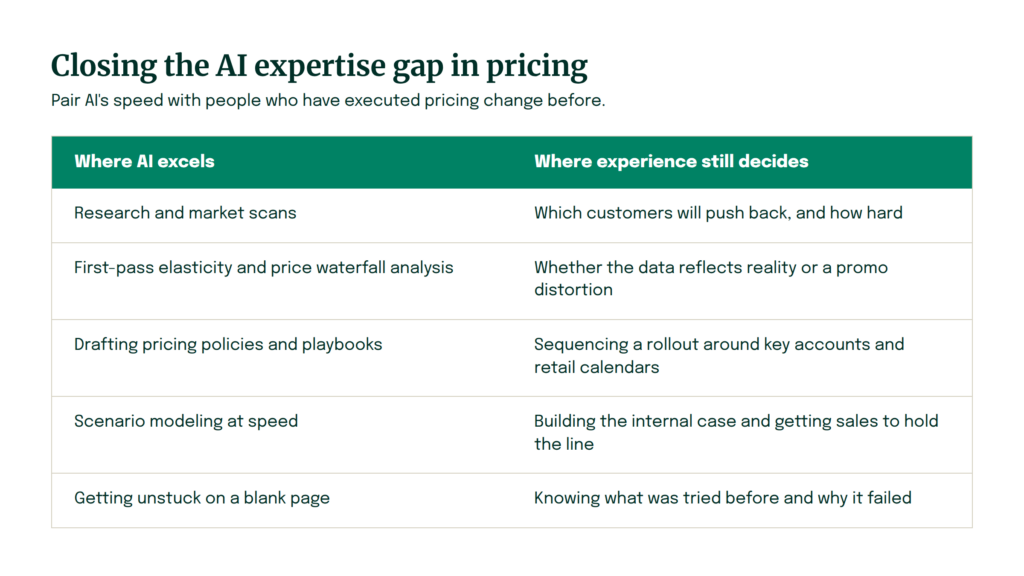
The answer is not less AI. It is pairing AI’s speed with people who have executed pricing change before.
Start with a better question
The question is no longer “Can AI do this?” The answer is almost always yes. The better question is “What are we optimizing for?” A fast answer, or confidence that the answer will hold up with real customers, real politics and real resistance?
I use AI every day for research, first drafts and getting past a blank page. It has made me faster. It has not replaced years of watching pricing strategies work, fail and work again for reasons that never appeared in the data.
Frequently asked questions
Can AI replace a pricing consultant?
AI can replace much of the analysis a pricing consultant used to do by hand, such as elasticity reads and price waterfalls. It cannot replace the execution work: aligning sales, negotiating with key accounts and holding pricing discipline after launch.
What are the limitations of AI pricing tools?
AI pricing tools only see the data you give them. They miss customer relationships, internal politics, contract nuances and the history of past pricing attempts, which are often what decide whether a strategy succeeds.
What is the hidden cost of an AI-built pricing strategy?
The hidden cost is margin left on the table. A suboptimal price architecture does not appear as a loss, so teams rarely find out what they could have earned with a better strategy.
How should mid-market companies use AI in revenue growth management?
Use AI to speed up research, data analysis and scenario modeling. Pair it with experienced RGM practitioners who can pressure-test the outputs and lead the change management needed to make new pricing stick.
Why is pricing strategy execution harder than analysis?
Execution requires changing behavior across sales, finance and customers. Pricing work is roughly 20% analysis and 80% execution, and the execution portion depends on persuasion, negotiation and consistency that no model can supply.
The bottom line
AI can tell you exactly where the drain valve is. It can’t tell you how to remove the panel without breaking the light attached to it. That comes from having done the job before, more than once, and getting it wrong at least once along the way.
Pricing is no different. At Revenue Management Labs, we combine AI-driven analysis with practitioners who have designed and executed pricing and RGM programs across CPG, manufacturing, distribution and private equity portfolios. See how we help mid-market companies turn pricing analysis into results.
This article originally appeared in Forbes as part of the Forbes Business Council.