

Summary
SaaS pricing consulting matters less for brand name than for fit. The best partner depends on your stage, data depth, go to market motion, and pricing problem.
A seed stage founder packaging a new product needs a different firm than an enterprise SaaS company untangling legacy discounts, usage metrics, billing systems, and global sales enablement. Use the framework below to evaluate any shortlist of b2b SaaS pricing strategy consultants against your revenue model, team capacity, and rollout risk.
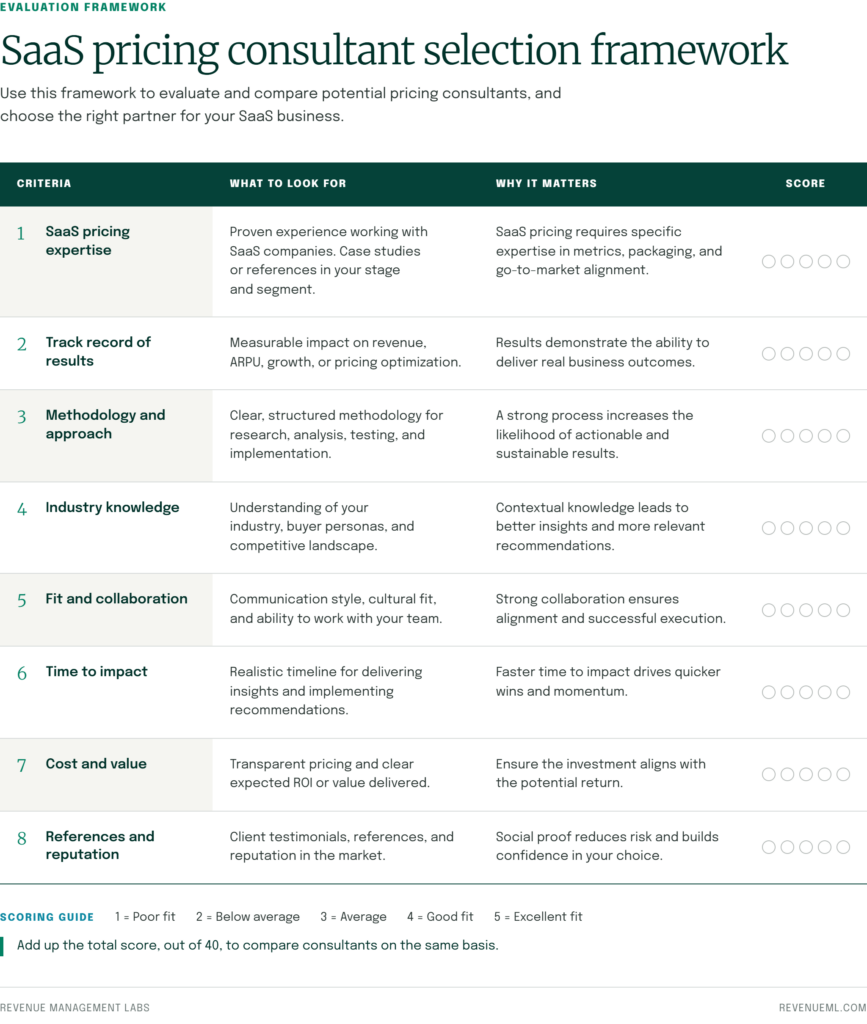
What kind of SaaS pricing consulting firm should you look for?
The best shortlist is stage based: choose a consultant whose usual work matches your current complexity, not the company you hope to be in three years. If pricing is mainly a founder led decision, you need research, clarity, and fast execution. If pricing touches sales compensation, billing, product entitlements, customer success, finance, and RevOps, you need a partner that can handle rollout as much as strategy.
SaaS pricing consultants tend to fall into a few broad categories, and it helps to know which one you actually need:
- Early stage research specialists, who focus on customer interviews, willingness to pay testing, and a first clean version of your pricing architecture.
- Packaging and monetization strategists, who work through customer research, usage analysis, packaging design, price ranges, and launch playbooks for growth stage companies.
- Usage based and AI pricing specialists, who focus on metering, hybrid models, discount creep, and migrating customers off legacy plans.
- Product led growth specialists, who treat pricing as part of activation, onboarding, and self serve conversion.
- Enterprise monetization and governance firms, who bring pricing governance, organizational alignment, and large scale rollout experience for complex, multi team decisions.
Whichever category fits, ask any firm you shortlist to walk you through a past project at your stage and complexity level, not just their general philosophy.
Match the firm to your stage and pricing challenge
For early stage SaaS, the biggest risk is usually underpricing, copying competitors, or building packages that do not map to the buyer’s real value perception. At this stage, you may not need a large transformation program. You need interviews, willingness to pay signals, segmentation, a usable pricing page, and a clean first version of your pricing architecture.
For growth stage SaaS, pricing tends to become cross functional. You may have multiple ICPs, a sales team asking for discount flexibility, customers on old plans, new modules to monetize, and investors expecting stronger expansion revenue. This is where pricing optimization services become more valuable, because the work is not just raising prices; it is redesigning value metrics, packaging, entitlements, migration rules, and sales enablement.
For enterprise SaaS, pricing becomes an operating system. You may need governance, approval rules, price books, regional guidance, CPQ changes, finance modeling, and executive alignment. At this scale, the deciding factor is less which specific firm you use and more whether they have handled a rollout of similar size and complexity, since the decision affects many teams and the cost of a bad rollout is high.
What should a SaaS pricing consultant actually do?
A good SaaS pricing consultant should help you decide what to charge, how to package value, which metric should scale with customer success, how discounts should work, and how the new model will be launched without confusing buyers or upsetting the installed base. The work should combine customer research, quantitative analysis, competitive context, financial modeling, and rollout. If a consultant only gives you a new price grid, the engagement is probably too shallow.
A complete SaaS pricing strategy engagement often includes:
- Customer and buyer research. Interviews should uncover why customers buy, what alternatives they compare you against, which outcomes matter, and which features create willingness to pay.
- Segmentation and packaging. Packages should separate users or accounts by value, maturity, use case, or willingness to pay rather than by an arbitrary list of features.
- Value metric design. The value metric might be seats, usage, transactions, contacts, workflows, revenue processed, AI credits, or a hybrid. The right metric grows as customers receive more value.
- SaaS cost structure and margin analysis. This is increasingly important for AI and usage heavy products. If compute, API, data, support, or infrastructure costs rise with usage, the pricing model has to protect gross margin while staying predictable for customers.
- Discounting and deal governance. Sales teams need clear rules: what can be discounted, what should be traded for term length or scope, and when approvals are required.
- Rollout and enablement. The best strategy still fails if billing cannot support it, sales cannot explain it, or customer success cannot defend it at renewal.
This is also where revenue operations considerations for SaaS pricing models can matter. RevOps often owns the handoff between strategy and execution: CRM fields, CPQ logic, product usage data, renewal workflows, reporting, and sales compensation all need to reflect the new pricing model.
Specialist strengths to look for in competitive SaaS markets
If you are searching for the best SaaS pricing consulting options in competitive markets, do not over index on competitor benchmarking. Competitive pricing matters, but copying a rival’s tiers rarely tells you what your customers value or what your product can defend. The stronger move is to understand your edge, prove which segments value it, and build packaging that makes comparison easier for buyers.
Look for consultants who can show strength in these areas:
- Willingness to pay research: They should know how to test price sensitivity without asking customers a simple what would you pay question.
- Usage based and hybrid pricing: They should understand customer demand stability, vendor margin protection, metering, overages, and expansion paths.
- AI monetization: They should understand variable costs, credits, outcome metrics, and buyer confusion around volatile consumption.
- Sales led and product led motions: Pricing for enterprise sales is different from pricing inside a self serve funnel.
- Migration strategy: They should have a point of view on grandfathering, cohorts, communication, renewal timing, and customer risk.
- Post launch measurement: They should define the KPIs that tell you whether the pricing change is working.
Firms with real depth in these areas tend to describe their work in terms of trigger situations, such as moving from seat based to usage pricing, launching a new AI product, fixing discount creep, or migrating an installed base, rather than in generic strategy language.
How do you choose the right pricing consultant?
Choose the consultant who can explain your business model back to you clearly, identify the riskiest pricing decision, and show exactly how they will turn evidence into a launchable operating model. The right partner should make pricing feel less like guesswork and more like a disciplined growth system. The wrong one will impress you with frameworks, then leave your team with a deck that nobody can implement.
Use this evaluation checklist before signing:
- Ask what data they need first. Strong consultants will ask for customer segments, win loss notes, CRM data, discount patterns, churn reasons, usage data, gross margin, and sales call insights.
- Ask how they combine qualitative and quantitative evidence. You want both customer language and financial modeling, not just one or the other.
- Ask what the final outputs include. Look for packaging architecture, price points or ranges, value metric recommendations, migration plan, sales enablement, discounting rules, and measurement plan.
- Ask who does the work. Senior led strategy is different from a senior sales call followed by junior execution.
- Ask how they handle implementation. If billing, RevOps, legal, customer success, and sales are not considered, the project may stall.
- Ask for relevant examples. A consultant who has only worked on seat based SMB SaaS may not be right for enterprise AI usage pricing.
- Ask what they would not change. Good consultants do not change pricing for the sake of activity; they protect what already works.
Budget also matters, and it varies widely across the market: from sprint style engagements in the low five figure range for a narrow scope, up to six figure transformation programs for full packaging, governance, and rollout work at scale. Match the investment to the scope and risk of the decision in front of you, not to what any single firm charges by default.
Common mistakes that make pricing projects fail
The most common mistake is treating pricing as a number instead of a system. A flat plan price, a usage meter, or a new enterprise tier does not mean much unless it fits your buyer segments, product value, cost model, and sales motion.
Watch out for these failure patterns:
- Competitor copy pricing: You inherit someone else’s assumptions without knowing their margins, ICP, roadmap, or sales motion.
- Price only recommendations: The consultant changes the amount but ignores packaging, entitlements, discounts, and migration.
- No RevOps plan: The strategy cannot be quoted, billed, reported, or renewed cleanly.
- No customer migration plan: Existing customers are surprised, confused, or given permanent exceptions that undermine the new model.
- No sales enablement: Reps discount because they cannot explain the value story.
- No post launch review: The company never checks conversion, win rate, expansion, churn, discounting, or support impact.
These risks are why pricing work should sit close to product, finance, sales, marketing, customer success, and operations. A modern SaaS pricing strategy is not a spreadsheet exercise; it is a go to market decision with operational consequences.
The practical takeaway
If you are under $10M ARR, start with a focused consultant who can clarify your ICP, packaging, and willingness to pay without overbuilding the process. If you are scaling fast, prioritize pricing optimization services that include segmentation, value metrics, discounting, migration, and enablement. If you are enterprise or AI heavy, look for deeper b2b SaaS pricing strategy consulting with strong RevOps and monetization systems experience.
The right pricing partner will not simply tell you to charge more. They will help you understand where value is created, how customers want to buy, how your SaaS cost structure affects margins, and how to launch a model your team can actually run. Firms that organize this work around a small set of commercial levers, such as price, discounts, mix, and terms, and ground each recommendation in value, financials, and market conditions (an approach used by firms like Revenue Management Labs) tend to produce models that are easier to implement and defend at renewal, rather than a one time price change that fades within a year.
Q&A
Question: Should a SaaS company choose the most famous pricing consulting firm by default?
Short answer: No. The best fit matters more than brand recognition. A seed stage company may need fast research, packaging clarity, and willingness to pay validation, while an enterprise SaaS company may need governance, CPQ changes, price books, migration planning, and cross functional rollout support. The best firm is the one whose usual work matches your current stage, pricing complexity, data maturity, and implementation risk.
Question: What outputs should you expect from a strong SaaS pricing consultant?
Short answer: A strong engagement should produce more than a new price grid. Useful outputs can include customer and buyer research, segmentation, packaging architecture, value metric recommendations, price points or ranges, margin analysis, discounting rules, customer migration planning, sales enablement, and post launch measurement. The consultant should connect strategy to execution so the model can be quoted, billed, sold, renewed, and measured.
Question: When does a SaaS company need specialist help with usage based, hybrid, or AI pricing?
Short answer: Specialist help becomes more important when pricing depends on variable usage, compute costs, AI credits, outcome metrics, overages, or customer migration from an older model. These situations affect both revenue and gross margin, and they can create buyer confusion if consumption is volatile. Firms with usage based, hybrid, AI monetization, and RevOps experience are better suited when pricing must balance customer demand stability with vendor margin protection.
Question: How should budget influence the choice of SaaS pricing consultant?
Short answer: Budget should be matched to the scope and risk of the pricing decision. Published pricing for SaaS pricing engagements varies widely, from sprint style projects in the low five figure range up to six figure transformation programs for enterprise scale rollouts. A focused early stage project may not need an expensive transformation program, while a complex enterprise rollout may justify a larger investment because implementation failure can affect sales, billing, renewals, and customer trust.