Summary
Discover how a variable pricing strategy enhances ecommerce success. Learn about Amazon’s approach, dynamic pricing models, and flexible pricing strategies to boost revenue and customer trust.
Variable pricing strategy
Prices rarely stay still in modern ecommerce. A well-designed flexible pricing strategy helps a business adjust prices based on demand, timing, inventory, customer segments, and competitive pressure without guessing or reacting too late. Amazon’s variable pricing strategy is often discussed because it shows how large online marketplaces can use data, automation, and testing to keep prices responsive while still trying to protect customer trust.
What is variable pricing strategy, and why does it matter?
A variable pricing strategy is a pricing approach where the price of a product or service changes under defined conditions instead of staying fixed for every buyer and every moment. Those conditions might include seasonality, stock levels, purchase volume, location, customer type, competitor pricing, or demand patterns. In simple terms, if you have ever wondered “what is variable pricing strategy,” the answer is this: it is a structured way to charge different prices in different situations so the price better reflects market reality.
For ecommerce teams, this matters because online shoppers compare prices quickly. A fixed price can be too high when competitors discount aggressively, or too low when demand spikes and inventory is limited. Variable pricing gives businesses more room to respond, but it also adds responsibility: customers need to feel that price changes are fair, understandable, and not manipulative.
How Amazon’s approach made variable pricing familiar
Amazon’s variable pricing strategy is not simply “raise and lower prices at random.” It is commonly understood as a highly automated approach that considers signals such as demand, competitor activity, product availability, marketplace seller behavior, and customer response. Prices on large ecommerce platforms can shift often because the environment changes often: a competitor runs out of stock, a seller changes a listing, a seasonal trend appears, or demand rises after a promotion.
For smaller businesses, the useful lesson is not to copy Amazon at full scale. Most brands do not need marketplace-level automation on day one. The lesson is that pricing works best when it is connected to data, not just instinct. Even a basic rule such as “reduce price when stock is aging” or “offer volume discounts to high-intent buyers” can turn pricing into a more active growth lever.
Amazon also highlights the trust challenge. Customers may accept changing prices when they understand the reason, such as a limited-time sale or a coupon. They are less forgiving when they feel two similar customers are being treated unfairly or when a price appears to jump during a moment of need. That is why transparency, consistency, and careful guardrails matter as much as automation.
Variable pricing and dynamic pricing are related but not identical
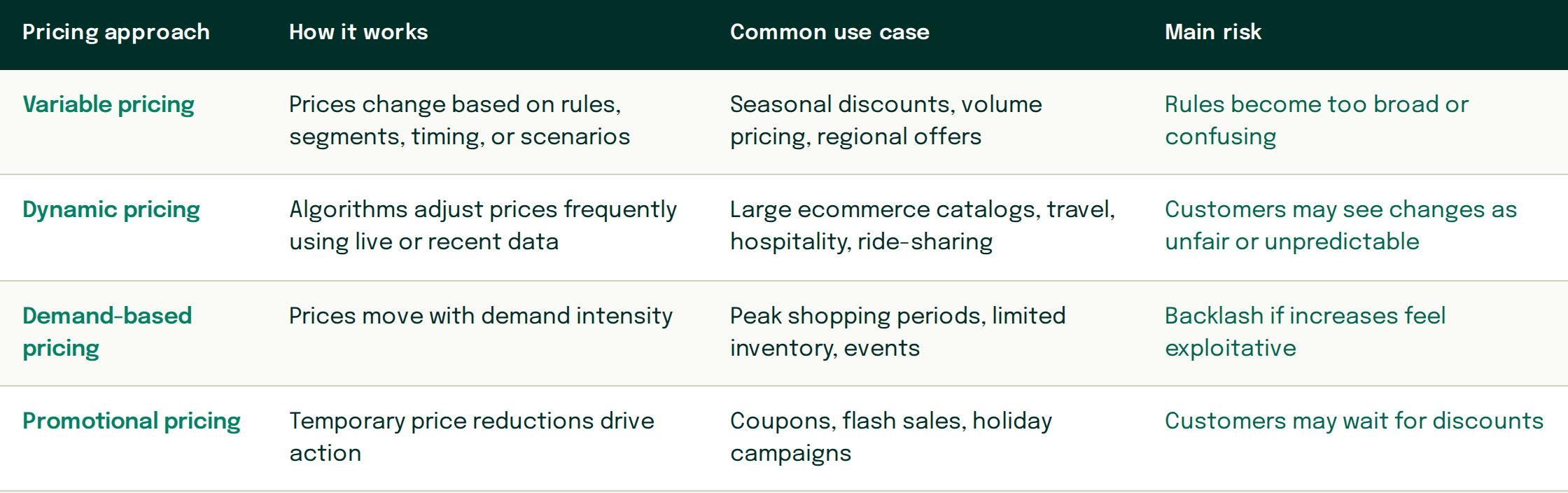
Variable pricing is the broader idea of changing prices based on predefined factors, while a dynamic pricing model usually refers to more frequent, algorithm-driven adjustments based on current market conditions. A variable system can be simple and rules-based; a dynamic system is often more automated, data-intensive, and responsive in near real time. In practice, many ecommerce businesses use a blend of both.
A store might use variable pricing by offering lower prices during off-peak seasons, special rates for bulk orders, or discounts for specific customer segments. A dynamic pricing model might go further by continuously adjusting prices as competitor prices, demand, and inventory shift throughout the day.
The difference matters because it affects technology, staffing, and customer communication. A small catalog may only need planned rules and periodic review. A large marketplace or fast-moving retailer may need automation, monitoring, and stricter governance to prevent pricing errors.
Common pricing strategy examples in ecommerce
There is no single best model for every business. The right approach depends on margins, competition, customer expectations, operational complexity, and how much pricing data the business can reliably collect. These pricing strategy examples show how variable pricing can work without becoming chaotic.
- Volume discounts: A buyer pays less per unit when purchasing more. This can increase average order value and move inventory faster, especially for consumables, supplies, or business purchases.
- Seasonal pricing: Prices rise or fall around predictable demand cycles. Retailers often use this for holiday items, apparel, outdoor goods, and event-related products.
- Inventory-based pricing: Slow-moving products receive discounts, while scarce items keep firmer prices. This helps balance margin protection with stock turnover.
- Segment-based offers: Different customer groups receive different promotions, such as first-time buyer discounts, loyalty rewards, or business account pricing.
- Geographic pricing: Prices vary by region because of shipping costs, local competition, taxes, or demand differences. This must be handled carefully so customers understand the logic.
- Demand-based pricing: Prices reflect demand intensity. For example, a product may hold a higher price during peak interest and receive incentives when demand cools.
A practical variable pricing strategy example might be an online electronics seller adjusting discounts based on stock age and competitor movement. If a product has sat in the warehouse too long and competing sellers lower their prices, the retailer may apply a limited discount. If demand returns and inventory becomes tight, the discount can be removed rather than permanently lowering the product’s perceived value.
Why businesses use a flexible pricing strategy
A flexible pricing strategy gives businesses more control over revenue, margin, and inventory. Instead of treating price as a static label, the company treats it as a decision that can be improved over time. This is especially useful in ecommerce, where customer behavior and competitor moves are visible quickly.
The biggest benefit is responsiveness. If demand increases, prices do not have to remain artificially low. If a product underperforms, the business can test incentives before writing off the inventory. If a competitor starts a promotion, the business can decide whether to match, hold firm, bundle value, or target a specific customer segment rather than discounting everything.
Variable pricing can also support personalization when used responsibly. A customer who abandoned a cart might receive a reminder with a modest incentive. A loyal customer might get early access to a promotion. These tactics can feel helpful when they are framed as benefits, but they can feel invasive if customers believe the business is secretly charging them more because of who they are.
The most successful pricing teams usually combine commercial goals with customer expectations. They ask not only “Can we charge this?” but also “Will customers understand why this price changed?” That second question is often what separates smart pricing from short-term margin chasing.
What can go wrong with variable pricing?
Variable pricing can damage trust when customers believe the system is unfair, opaque, or opportunistic. The risk is not only that someone dislikes a price; it is that they feel the business is taking advantage of them. Once that perception spreads through reviews, social media, or word of mouth, the revenue gained from aggressive pricing can be outweighed by reputational damage.
Several issues appear again and again:
- Unclear logic: Customers see prices change but cannot understand why.
- Over-personalization: Shoppers suspect they are being charged more based on browsing behavior or personal data.
- Price whiplash: Prices change so often that customers delay buying or lose confidence.
- Internal complexity: Sales, support, marketing, and finance teams cannot explain or manage the pricing rules.
- Competitive spirals: Automated repricing tools chase competitors downward until margins suffer.
A good pricing system needs boundaries. For example, teams can set minimum margin thresholds, limit how often prices change, review sensitive product categories manually, and avoid sudden increases during emergencies or high-stress moments. These guardrails do not make variable pricing less strategic; they make it more sustainable.
Building a responsible pricing system
The best way to implement variable pricing is to start with clear rules, test carefully, and expand only when the business can explain and manage the results. Jumping directly into full automation can create problems if the data is messy or if teams do not agree on the goals.
A practical rollout might look like this:
- Define the objective. Decide whether the priority is margin, revenue, inventory movement, customer acquisition, or retention.
- Choose a narrow test area. Start with one product category, customer segment, or promotion type instead of changing the entire catalog.
- Set rules and limits. Establish minimum prices, maximum discounts, review triggers, and customer-facing messaging.
- Measure more than sales. Track margin, conversion rate, returns, complaints, repeat purchases, and customer service questions.
- Improve with data. Use what you learn to refine segments, timing, and offer design before adding more automation.
Technology can help, but it cannot replace judgment. CRM data, pricing tools, analytics platforms, inventory systems, and AI-supported forecasting can make pricing more accurate and scalable. Still, people need to decide what the brand stands for, which customer experiences are acceptable, and where automation should stop.
Customer trust is part of the pricing strategy
Customers do not need to know every detail of a pricing algorithm, but they do need a sense of fairness. Clear labels such as “limited-time offer,” “bulk discount,” “member price,” or “seasonal sale” make price differences easier to accept. The more understandable the reason, the less likely customers are to assume the worst.
Trust also improves when businesses reward customers rather than only extracting more from them. Loyalty benefits, price-drop notifications, transparent promotions, and consistent refund or price adjustment policies can make variable pricing feel like a better shopping experience. The goal is not to explain every calculation; it is to show that the customer is not being tricked.
For teams studying Amazon’s variable pricing strategy, this is the most important takeaway. Scale and automation may win attention, but trust keeps customers coming back. A pricing system that improves short-term revenue while training customers to distrust the brand is not a strong system.
The takeaway
Variable pricing helps ecommerce businesses respond to demand, competition, inventory, and customer behavior with more precision than fixed pricing. It includes simple tactics like volume discounts and seasonal offers, as well as more advanced dynamic pricing model applications powered by data and automation.
The opportunity is real, but so is the responsibility. Start with clear objectives, use rules before heavy automation, protect margins with guardrails, and communicate price differences in ways customers can understand. When pricing feels flexible, fair, and useful, it becomes more than a revenue tactic; it becomes part of a stronger customer experience.