
Summary
A strong go to market strategy turns a SaaS product from ready to launch into something the right buyers can understand, try, trust, and pay for.
A SaaS go to market strategy for freemium products has to connect product experience, customer acquisition, pricing strategy, sales, marketing, and retention into one system.
Go to market strategy services help teams make those choices with more structure. They clarify who the product is for, why it matters, how buyers find it, and what moves free users to paid plans.
What makes a freemium SaaS go to market strategy work?
A freemium SaaS go to market strategy works when the free product creates real value, attracts the right users, and gives them a clear reason to upgrade.
The free tier should not be a random giveaway; it should be built as an acquisition channel, an onboarding path, and a sales signal for future revenue.
The strongest freemium models usually balance three goals. First, they cut friction so users can see value fast. Second, they create natural upgrade moments, such as usage limits, team features, advanced reports, or better support. Third, they collect enough behavior data to help sales and marketing focus on the users most likely to convert.
This is where go to market strategy services can be useful. A strategy partner can help connect product choices to revenue results, make sure the free plan supports the business model, and avoid waste.
In practical terms, that means defining the right audience, mapping conversion paths, aligning teams, and choosing metrics that show whether growth is healthy.
Start with a sharper target audience
Freemium often attracts a wide range of users, but not every sign-up is a sign of traction. A large free user base can look exciting while hiding weak fit, poor activation, or low willingness to pay.
The initial task is to clearly identify the target audience to make product, messaging, and sales decisions simpler.
A useful audience definition goes beyond company size or job title. It needs to pinpoint the issue, urgency, buying situation, existing options, and events prompting the search for a solution.
For example, a small team trying to automate reporting has a different buying motion than an enterprise group reviewing workflow control.
A clear audience profile should include:
- Primary user: The person who signs up, tests the product, and feels the pain directly.
- Economic buyer: The person or team that approves pricing and budget.
- Activation behavior: The actions that show a user has reached meaningful value.
- Upgrade pressure: The limit, risk, or chance that makes paid access worth it.
- Best-fit segments: The industries, company sizes, or workflows where the product is easiest to adopt and expand.
When these details are clear, customer acquisition becomes more efficient. Marketing can speak to real pain points, sales can focus on qualified accounts, and product teams can prioritize features that support conversion rather than chase every request.
Analyzing competition leads to better positioning.
Competitive analysis is not just a slide that lists similar tools. For a freemium SaaS company, it should explain how buyers compare options, what they expect to get for free, where competitors create friction, and which value promises are too common to stand out.
This analysis should look at direct competitors, indirect alternatives, and the do nothing option. Many SaaS products are not only competing against other software; they are competing against spreadsheets, manual workflows, internal tools, or the belief that the problem is not urgent enough to solve.
The output should guide brand strategy as much as product packaging.
If every competitor claims to save time, the brand may need to emphasize confidence, control, simplicity, focus, or speed to value.
If competitors gate key onboarding features behind paid plans, a generous free experience may become a key edge.
If the market is crowded with low-cost tools, premium positioning may need stronger proof, clearer outcomes, and a more consultative sales approach.
Build the freemium offer around conversion moments
The free plan should give users enough value to trust the product, but not so much that there is no reason to upgrade. This balance is delicate.
If the free tier is too limited, users leave before they understand the value. If it is too generous, the company may support a large audience that never converts.
A practical freemium offer usually sets limits around usage, collaboration, automation, integrations, data history, support, security, or advanced insights. The right limit depends on the product value metric.
For some SaaS tools, that metric may be seats or projects. For others, it may be contacts, workflows, storage, reports, or actions completed.
Good upgrade triggers feel logical rather than punitive. A user should think, I need more because this is working, not, I am being blocked before I can judge the product.
That is why you should map onboarding, in-product prompts, lifecycle email, and sales handoffs together.
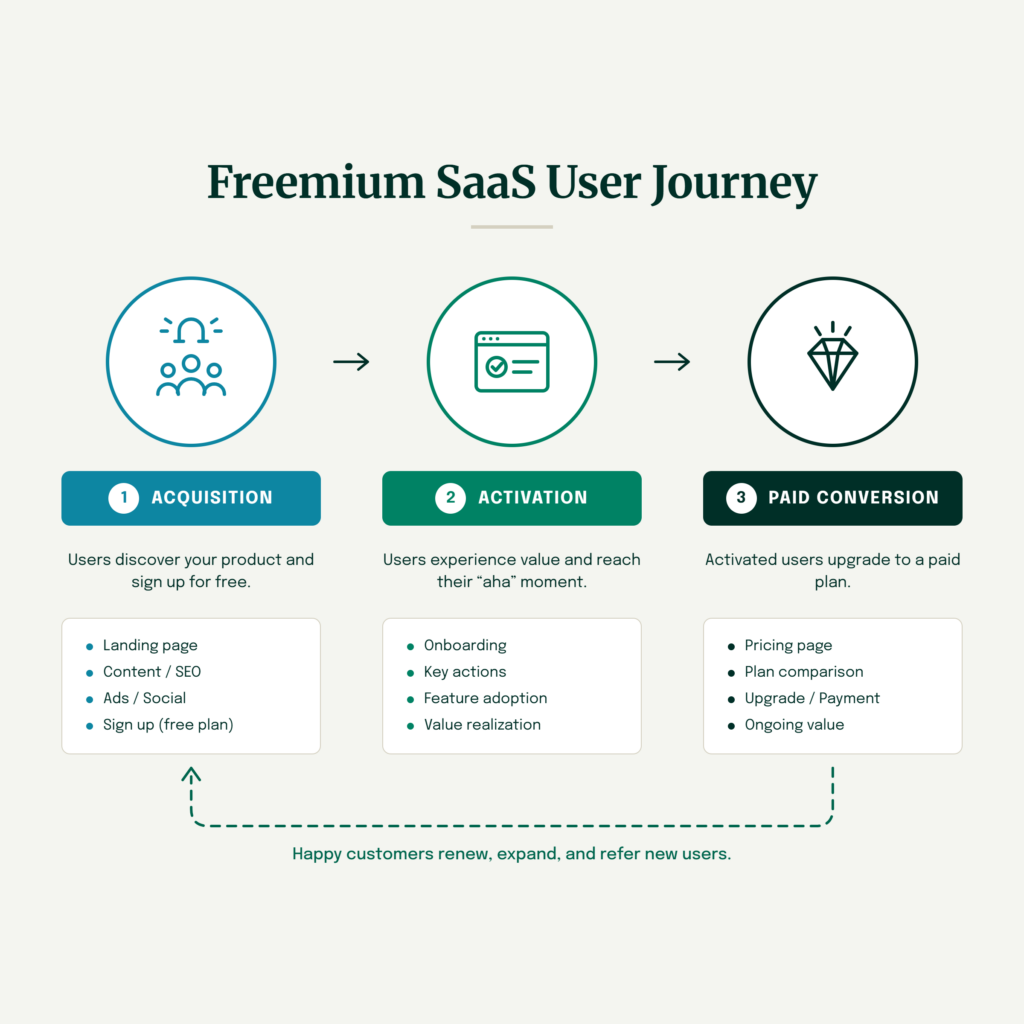
A simple conversion path might look like this:
- Acquisition: A user discovers the product through search, social proof, referral, content, ads, or partner channels.
- Activation: The user completes a core action and sees the product solve a real problem.
- Engagement: The user repeats the action, invites teammates, or connects key data.
- Expansion signal: The account reaches a usage, collaboration, or workflow threshold.
- Upgrade prompt: The product, marketing, or sales team presents a paid plan tied to the user’s next goal.
- Retention: The paid customer keeps getting value, support, and reasons to expand.
How should pricing strategy support a freemium model?
Pricing strategy should support the way users feel value, the way buyers approve budget, and the way the company plans to grow revenue.
In a freemium model, pricing is not just a page on the website; it is part of the product journey.
The free tier creates the entry point, but paid tiers need to make the upgrade decision simple. If buyers cannot quickly understand what changes between plans, they may delay or choose a competitor.
See-through packaging shows how features lead to outcomes like saving time, teamwork, visibility, risk reduction, or workflow expansion.
Pricing should also reflect the company’s sales motion. A low-friction self-serve product may need simple monthly or annual plans with transparent limits. A product that serves larger teams may need usage-based pricing, sales-assisted plans, or custom packages.
The best structure depends on how customers adopt the product, how value expands, and how much guidance is needed to close the deal.
Common signs that pricing needs attention include:
- Free users are active but rarely upgrade.
- Users upgrade but quickly churn because expectations were unclear.
- Sales teams often discount because value is not well explained.
- High-fit accounts ask for capabilities that do not match current packages.
- The paid plan gates features users need before they can feel success.
The goal is not to copy a competitor’s pricing. It is to create a pricing model that feels fair, supports conversion, and improves revenue steadiness.
Match the sales approach to user behavior
Freemium does not mean sales disappears. It means the sales approach should match the signals users create inside the product.
Some users will convert through self-serve checkout. Others will need education, procurement support, security review, setup help, or a business case.
A useful GTM strategy separates accounts by behavior and potential. Product-qualified leads may include users who invite teammates, hit usage limits, connect integrations, or use advanced workflows again and again.
Sales teams can focus on these signals instead of reaching out to every free sign-up.
Small accounts may automate the sales motion mostly through onboarding emails, in-app messaging, webinars, and helpful upgrade prompts. For larger accounts, sales may step in when multiple users from the same company are active or when the product is spreading across teams.
This creates a more efficient system because human effort is saved for opportunities where it can change the outcome.
AI and automation can support this process by routing leads, personalizing follow-up, assisting campaign management, and helping marketing and sales teams work from shared data.
Tools such as GTM AI platforms can cut repetitive work, but they still need a clear strategy behind them. Automation performs best when you have already defined the audience, message, offer, and handoff rules.
Marketing tactics should educate before they sell
Freemium SaaS marketing works best when it helps users understand a problem, try a solution, and build confidence through experience.
Choosing the best marketing strategies relies on the audience and category. They should guide the journey stages: awareness, activation, engagement, conversion, and retention.
Content marketing can explain pain points and use cases. Search strategy can capture users actively looking for alternatives. Paid campaigns can test audience segments and messaging.
Community, templates, webinars, and product-led education can help users reach value faster. Lifecycle email can nudge users toward the next best action after sign-up.
A practical marketing mix may include:
- Educational content that answers high-intent questions and shows how the product fits real workflows.
- Use-case landing pages for different teams, industries, or pain points.
- Onboarding campaigns that guide users to the first meaningful product outcome.
- Retargeting and nurture for users who signed up but did not activate.
- Customer proof and social validation once the company has real examples to share.
- Product-led prompts that introduce paid features at the moment they become relevant.
The most important point is alignment. Marketing should not promise one thing while the product experience delivers another.
The brand strategy, messaging, onboarding, and pricing must tell the same story.
Measure unit economics, not just sign-ups
A freemium model can generate strong top-of-funnel numbers, but investors and operators care about whether those numbers turn into durable revenue. Sign-ups, website traffic, and free accounts matter, but they are not enough on their own.
Teams should track metrics across the full GTM funnel:
- Visitor-to-sign-up rate to understand acquisition efficiency.
- Activation rate to see whether users reach meaningful value.
- Free-to-paid conversion rate to evaluate revenue.
- Customer acquisition cost to understand how expensive growth is.
- LTV:CAC ratio to assess whether customer value supports acquisition spend.
- CAC payback period to estimate how quickly acquisition costs are recovered.
- Retention and expansion to show whether paid customers keep growing in value.
Many investors look for proof that acquisition can become repeatable and scalable. A common benchmark is an LTV:CAC ratio above 3:1. CAC payback is usually expected in 12 to 18 months, but this can vary based on market, stage, and sales model.
For an early-stage SaaS company, the real value is not pretending the metrics are perfect; it is showing that the team understands the levers and is improving them with intent.
What should a go to market strategy service deliver?
A go to market strategy service should deliver a clear, practical operating plan for reaching the right customers, converting them well, and learning from the market.
It needs to cover more than just messaging and checklists, including positioning, pricing, sales, marketing, and measurement.
Depending on company stage, the work may include audience research, competitive analysis, brand strategy, packaging, pricing recommendations, channel strategy, sales process design, lifecycle marketing, funnel diagnostics, and investor-facing GTM stories.
A freemium SaaS company needs to set activation goals, upgrade triggers, lead criteria, and manage conversions.
The best outcome is focus. Founders and growth teams should know which audience to prioritize, which channels to test, what message to lead with, how to structure the free and paid tiers, and which metrics will prove whether the strategy is working.
A focused GTM plan turns freemium into a growth engine
Freemium can be a powerful SaaS growth model, but only when it is designed with discipline. The free experience must attract the right users, show value quickly, and create a natural path toward paid adoption.
Go to market strategy services help turn that path into a repeatable system. With a defined target audience, thoughtful pricing, clear brand strategy, strong marketing tactics, a signal-based sales approach, and disciplined measurement, SaaS teams can move beyond scattered tests and build a GTM motion that supports steady growth.ntries or business units, speak with RML about what the work requires and how we would approach it.