

Summary
Discover effective tiering and pricing strategies to optimize business growth. Learn how tiered pricing strategies can enhance customer satisfaction and maximize profitability.
Tiering and pricing strategies
Tiering and pricing strategies are used to package offerings in a way that is clear to customers and sustainable for the business. Rather than offering one option to everyone, a tiered pricing approach creates choices based on usage, features, support, outcomes, or customer maturity. When designed carefully, it can simplify selection, reflect differences in customer needs, and create a consistent path for expansion as requirements change.
What are tiering and pricing strategies?
Tiering and pricing strategies are the methods a business uses to group its products or services into different paid options and assign prices to each one. A simple example is a basic, standard, and premium plan, where each tier includes a different level of access, service, or value. The goal is not simply to charge more for more features; it is to help different customer segments select the option that matches their needs.
Pricing strategies typically connect three factors: what customers value, what the business can deliver sustainably, and how buyers make decisions. Tiered pricing provides a structure for that connection. It turns a single offer into a set of choices, which can reduce friction for smaller customers while still allowing higher-need customers to select plans that better match their requirements.
This is why tiered pricing strategies are common in software, subscriptions, memberships, professional services, ecommerce, media, and physical products. A business might tier by number of users, product quantity, service speed, customization, access level, account support, or usage volume. The details vary by industry, but the underlying idea is consistent: different customers have different needs, and pricing can reflect that variation.
Why does tiered pricing work for both customers and businesses?
Tiered pricing can work because it gives customers options while helping businesses align revenue with the value delivered and the cost to serve. Buyers can choose a starting point that fits their current needs, then upgrade when their usage grows or additional capabilities become relevant. For the business, the model can support expansion without requiring constant changes to the core offer.
A single price can be limiting. If it is too low, high-need customers may receive more than the price accounts for. If it is too high, entry-level buyers may opt out before they can evaluate the offer. Tiered pricing addresses this by creating several entry points into the same product or service.
It can also clarify positioning. A well-designed tier structure makes it easier to explain who each plan is for. The lowest tier may support individuals or small teams, the middle tier may serve growing organizations, and the highest tier may fit customers who need advanced capabilities, priority service, or greater scale.
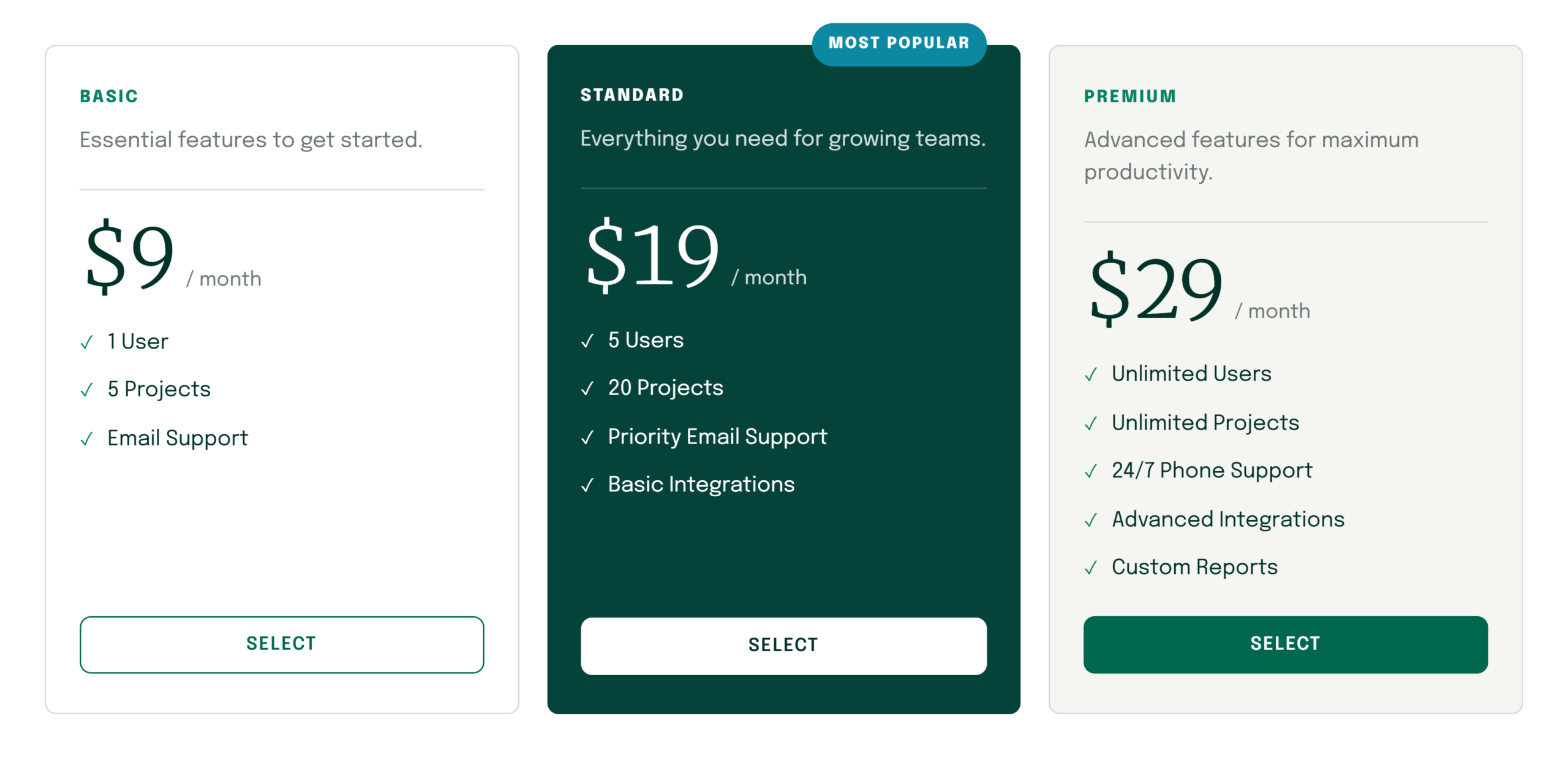
For customers, one benefit is clarity: they can compare options and see what changes across tiers. For businesses, one benefit is flexibility: a tiered model can support acquisition, retention, and account growth when it reflects real differences in customer needs.
The main building blocks of strong pricing strategies
Before creating tiers, a business needs to understand the foundation of its pricing. Tiers are not just boxes on a pricing page. They reflect decisions about value, segmentation, cost, positioning, and customer behavior.
Customer segments
Customer segments are groups of buyers with similar needs, expectations, budgets, or use cases. A pricing model that ignores segmentation often feels either too expensive for some buyers or too limited for others. The more clearly a business understands its segments, the easier it becomes to create tiers that follow customer logic.
For example, an individual user may care about affordability and ease of use. A growing team may care about collaboration and reporting. A larger organization may care about security, integrations, permissions, or dedicated support. These differences can inform tier design.
Value metrics
A value metric is the unit that connects price to customer value. In a subscription product, it could be users, seats, projects, storage, messages, contacts, transactions, or usage volume. In a service business, it might be response time, deliverables, complexity, frequency, or level of strategic involvement.
Effective value metrics are easy to understand and closely tied to the customer’s results. If the metric feels arbitrary, customers may resist it. If it scales with value received, customers are more likely to accept paying more as their needs increase.
Feature packaging
Feature packaging determines which capabilities belong in each tier. This is where many businesses overcomplicate their offers. If every tier has a long list of small differences, buyers can feel overloaded. If the differences are too vague, they may struggle to evaluate when upgrading makes sense.
Clear packaging creates a progression. The entry tier should solve a real problem and provide a usable experience. The middle tier often reflects the most common set of needs. The top tier typically includes advanced capabilities that matter to customers with higher requirements.
Price fences
Price fences are the boundaries that explain why one customer pays more than another. They can be based on usage, access, service level, customization, or business size. A price fence is easier to accept when it reflects a meaningful difference in value or cost to serve.
Weak price fences create confusion. If customers cannot understand why a feature sits behind a higher tier, they may view the structure as restrictive rather than helpful. The aim is to make upgrades feel like a logical next step.
Common tiered pricing models
There is no single version of tiered pricing. The right model depends on what is being sold, how customers use it, and how value increases over time. Many businesses combine elements from more than one model.
Feature-based tiers
Feature-based tiers separate plans by capabilities. The lower tier includes essential features, while higher tiers add more advanced tools, automation, reporting, permissions, integrations, or support. This model is common when customers have different levels of sophistication.
The advantage is that buyers can identify the upgrade path quickly. The risk is that core value is pushed too far into higher tiers, making the entry plan less useful. In practice, each tier should provide a complete solution for a defined type of user.
Usage-based tiers
Usage-based tiers increase price as customers use more of the product or service. This could be based on volume, transactions, storage, contacts, bandwidth, credits, or other measurable activity. It is often used when usage is closely tied to value received.
This model can feel equitable because customers pay more as they use more. However, it requires transparency. If customers cannot predict their bill or understand usage limits, the model may increase hesitation.
Seat-based tiers
Seat-based pricing charges according to the number of users, team members, or accounts. It is common in business software and team-based services. It is also relatively simple to explain: more users typically means a higher price.
The challenge is that not all users create equal value. Some may use the product daily, while others only need occasional access. Businesses using this model often consider whether viewer roles, admin roles, or limited-access seats need separate treatment.
Service-level tiers
Service-level tiers package different levels of support, speed, expertise, or customization. This model is common in consulting, agencies, technical services, operations support, and managed services. Customers pay more for deeper involvement, faster turnaround, or more complex work.
The benefit is that price can reflect effort and attention. The risk is setting expectations that are difficult to meet. Each tier should match what the business can reliably deliver.
Outcome-aligned tiers
Outcome-aligned tiers are organized around the customer’s desired result rather than a list of features. For example, a business might structure plans around launch, growth, and scale. Each tier includes the tools, services, or resources appropriate for that stage.
This approach can be useful because it mirrors how customers think about progress. It works best when the business understands the customer journey well enough to define each stage clearly.
How to design tiers that customers understand
Designing tiers is both a strategy and a communication task. The structure must make financial sense, and it also needs to be understandable when a buyer sees it for the first time. If customers have to study the pricing page extensively, the model may be too complex.
Start with the customer’s decision process. What are they trying to accomplish? What level of risk are they willing to take? What features or services become important only after they grow? These answers help separate essential value from advanced value.
A practical tiering process can look like this:
- Define your primary customer groups. Identify the smallest number of segments that meaningfully differ in needs, willingness to pay, or cost to serve.
- Choose a value metric. Select a pricing unit that customers understand and that grows with value delivered.
- Map core needs by segment. List what each customer group must have to succeed, not every feature they might want.
- Build a logical progression. Make each tier stronger than the previous one in a way that is easy to explain.
- Name the tiers clearly. Use names that signal fit or maturity without exaggeration.
- Review upgrade triggers. Identify the moment when a customer outgrows one tier and needs the next.
- Test for confusion. Check whether a new buyer can tell which tier is most appropriate in a short amount of time.
A common mistake is starting with internal assumptions instead of customer logic. A business may know its feature set intimately, but customers are usually comparing outcomes, risk, effort, and budget. Pricing works better when it translates internal complexity into buyer-friendly choices.
Mistakes that weaken tiered pricing
Even a strong offer can underperform if the pricing structure creates confusion or distrust. Many tiering issues come from trying to satisfy too many internal goals at once. The result can be a pricing page that reflects company complexity rather than customer decision-making.
Common mistakes include:
- Too many tiers. More options can add flexibility, but they can also slow decisions and make comparison harder.
- Unclear differences. If buyers cannot quickly tell why one tier costs more, they may default to the cheapest option or leave.
- Weak entry plans. A low tier that does not solve a real problem can change perception of the whole offer.
- Overloaded premium plans. Adding every feature to the top tier can make it feel unfocused rather than valuable.
- Poorly chosen limits. Usage caps or feature restrictions that feel arbitrary can frustrate customers.
- No upgrade logic. Customers should understand when and why they would move to the next tier.
- Ignoring cost to serve. A plan can appear attractive but fail operationally if it requires too much support or customization.
One practical approach is to simplify around the buyer’s journey. Each tier should answer a clear question: “Who is this for, and why would they choose it?” If that answer is hard to write, the tier may need adjustment.
How to know when your pricing tiers need an update
Pricing is rarely set once and left unchanged. Markets change, products mature, customer expectations shift, and internal costs evolve. When those factors move, older tiers can become misaligned with current value and usage patterns.
Signs your tiers may need attention include customers regularly choosing the wrong plan, frequent questions about what is included, heavy discounting, low upgrades, high support demand from lower tiers, or top-tier customers receiving more than the current price reflects. None of these signs automatically means the price is incorrect, but they suggest the structure may deserve a review.
Customer conversations are especially useful. Sales calls, support tickets, cancellation feedback, and onboarding questions can reveal where pricing feels unclear. If the same confusion appears repeatedly, the issue may be packaging and communication rather than the numeric price point.
A pricing review should examine both numbers and language. Sometimes tiers are financially reasonable but poorly explained. Other times the messaging is clear, but the value metric or boundaries no longer match how customers use the offer.
A practical checklist for better tiered pricing
A checklist can help keep a pricing review focused. Use it before launching a new pricing model or when refining an existing one.
Ask these questions:
- Does each tier serve a distinct customer type or use case? If two tiers target the same buyer with only minor differences, consider merging or repositioning them.
- Can buyers understand the main difference quickly? The primary contrast should be obvious without reading every line.
- Is the entry tier genuinely useful? It should deliver enough value to support engagement and evaluation.
- Does the middle tier reflect the most common needs? Many businesses design this as the most balanced option.
- Does the premium tier justify its price through meaningful added value? Advanced customers should see clear reasons to choose it.
- Are limits tied to value or cost? Caps and restrictions should make sense from the customer’s perspective.
- Is there a natural upgrade trigger? Growth, usage, complexity, or desired outcomes should explain when a customer moves up.
- Can the team deliver every promise sustainably? Pricing should reflect operational reality.
- Is the language customer-centered? Describe benefits and use cases, not just internal feature names.
- Have you removed unnecessary complexity? The easier the comparison, the easier the decision.
This checklist does not replace deeper research, but it can help identify weak spots. Many pricing improvements come from making value easier to understand rather than adding more tiers.
The role of messaging in pricing pages
A pricing structure is only as effective as the way it is communicated. Customers do not see the spreadsheet behind the tiers. They see names, prices, descriptions, limits, features, and calls to action.
Clear pricing page messaging reduces decision effort. Each tier can include a short positioning statement that indicates who it is for. For example, a business can explain that one tier is built for getting started, another for growing teams, and another for advanced needs.
Feature lists should be scannable without becoming exhaustive. Highlight the differences that matter most, then provide deeper details elsewhere if necessary. When every feature receives equal visual weight, comparison becomes harder.
It can also help to pair important features with short context. A feature such as “advanced permissions” is clearer when linked to its purpose, such as managing team access with more control. This does not require long explanations, but the most important differences should connect to practical use.
Tiering for services, products, and subscriptions
Although tiered pricing is often associated with software, it can work across many types of businesses. The key is adapting tiers to the way value is delivered.
For services, tiers may reflect depth of work, turnaround time, strategic involvement, deliverables, or access to specialists. A basic tier might cover a defined task, while a higher tier includes planning, implementation, and ongoing support. The boundaries need to be clear because service scope can expand quickly.
For products, tiers may be based on quality, quantity, features, bundles, warranties, customization, or customer support. The customer should be able to understand what makes one option more suitable than another. If the premium version is simply more expensive without a clear difference, it is harder to justify.
For subscriptions, tiers often combine usage, features, and support. The model should support long-term fit. Customers should not feel trapped in a tier that no longer works, and they should not need to contact support to understand whether upgrading is necessary.
In each case, tiering works best when it reflects customer progress: a buyer starts with a need, gets value, encounters new requirements, and then sees the next tier as a reasonable step.
Balancing simplicity and flexibility
One of the hardest parts of tiered pricing is balancing simplicity with flexibility. Customers want options, but they also want a decision that feels manageable. Businesses want to serve different segments, but every new tier adds complexity to marketing, sales, operations, support, and reporting.
A practical guideline is to keep the public pricing structure as simple as possible while allowing flexibility where it is genuinely needed. For many businesses, three or four visible tiers are sufficient. More complex needs can be handled through custom plans, add-ons, or sales conversations.
Add-ons can be useful when a capability is valuable to some customers but not central to a higher tier. However, too many add-ons can make pricing feel fragmented. If many customers buy the same add-on, it may belong in a tier.
Custom pricing can also be useful for large or complex customers. Still, it should not substitute for clear packaging. Even when final price requires a conversation, the buyer should understand what the custom option covers.
Measuring whether your pricing strategy is working
A pricing strategy should be evaluated by more than immediate sales. Short-term conversion matters, but so do retention, customer satisfaction, expansion, support load, and profitability. A tier structure that brings in many customers but attracts poor-fit accounts can create downstream issues.
Useful signals include plan selection patterns, upgrade rates, downgrade rates, churn by tier, average revenue per customer, support requests by plan, sales objections, and customer feedback. These signals should be interpreted together. For example, a low upgrade rate might mean customers are satisfied with the lower tier, or it might mean the higher tier does not present enough additional value.
Qualitative feedback is just as important. Customers may say a price is too high when the underlying issue is unclear value. Others may request features in lower tiers because they do not understand the purpose of higher tiers. Consistent feedback helps separate price resistance from packaging confusion.
Pricing should be reviewed deliberately. Constant changes can confuse the market and frustrate existing customers. Th
Thoughtful updates based on customer behavior and business constraints can improve alignment over time.
A clear takeaway for better pricing decisions
Tiering and pricing strategies are most effective when they make value easier to evaluate and purchase. They help customers identify a fit, understand upgrade paths, and see how price relates to needs. They also help businesses align revenue with delivery and segment differences.
Tiered pricing does not need to be complex to be useful. Start with customer segments, choose a value metric that fits how customers use the offer, package tiers around real needs, and use language that explains differences without overstating them.
Whether you are building pricing from scratch or refining an existing model, focus on fit and clarity. When tiers are logical and tradeoffs are easy to understand, pricing becomes a more straightforward part of the customer experience.