

Summary
Cottage cheese grew 19% last year while the cost of making it fell. A price-volume-mix split shows how unevenly the category captured it.
I just finished Off the Scales by Aimee Donnellan, the story of how Ozempic (a GLP-1) happened. Really liked it. Not just because she dedicates a whole chapter to talk about revenue management without mentioning revenue management, but because it got me thinking about the GLP-1 winners.
We hear and read about the losers everywhere, right? Big Food is in trouble. People eat less, lose appetite for some ultraprocessed snacks, and whole categories shrink.
The flipside is that people on these drugs don’t stop spending. They spend on different things, and a lot of it is going to the most boring (and coldest!) part of the store.
So I went looking for the winners. I expected protein bars, shakes, and whatever else gets built on purpose for a trend.
What I found instead was a trade piece on cultured dairy. And the numbers in it looked very familiar.
The aisle nobody had thought about
I spent ten years in big CPG, some of my time helping a cream cheese business. We watched cottage cheese take off right next door, and I don’t think any of us really knew what to do about it. It was the aisle nobody had thought about in twenty years.
It’s not that we sat still. New flavours, whipped formats, different pack sizes. Cream cheese still finished last year down 3%, and whipped was about the only meaningful part of it still growing. One shelf over, cottage cheese was up 19% having done none of that.
Here are the numbers. Cottage cheese did $2.1bn in the US last year, up 19%. That’s after 17% the year before, and 17% the year before that. The category is up around 60% in three years (Circana, 52 weeks to February).
But 19% isn’t the interesting number.
Splitting price from volume
Here’s the same Circana data with dollars and units split out by brand:
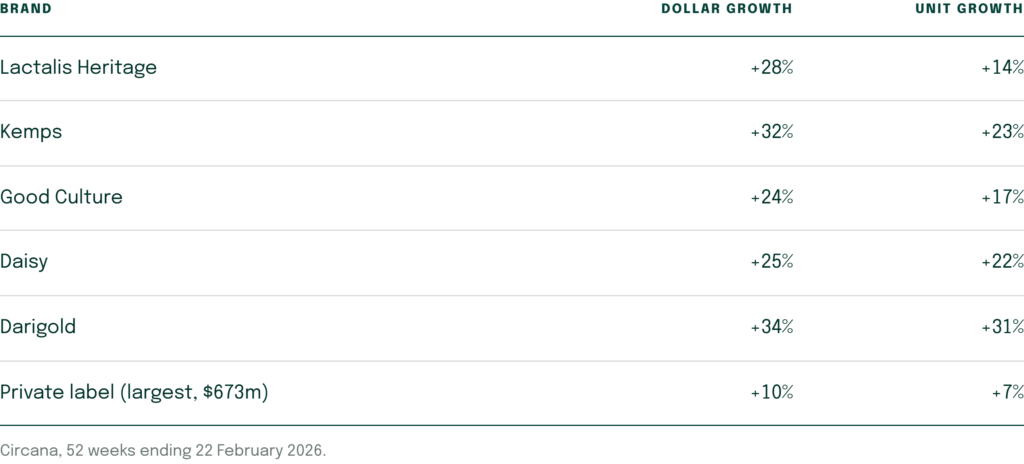
Run one of our favourite exercises on that: price-volume-mix.
About four and a half points of that category growth came from price and mix rather than volume. Second year running, at almost exactly the same rate.
And the facts keep getting more interesting. Over those same twelve months, the cost of making cottage cheese went down. The producer price index for it fell about 4%. Class II milk, the input cottage cheese is usually priced off, averaged 14% below the year before.
So for a category most people would call commoditised, this wasn’t cost pass-through. The category responded to demand and found out it could price. Beautiful!
Not everyone captured it evenly
Lactalis got about 12 points of price and mix. Kemps got 7. Good Culture got 6. Daisy got two and a half. Darigold got two.
Look at the bottom three: Darigold at 2.3, Daisy at 2.5, private label at 2.8. A regional co-op, the number two brand, and a private label, all within half a point of each other. In a year when the input index fell 4%, that’s a real price move of nearly four points. It’s a good result, and everybody captured it.
The three brands above them spread across six points. My guess is that part of that gap didn’t come off the shelf price at all.
Darigold is the one worth studying. It grew units 31%, more than twice the category rate, and took a base price move as good as anyone’s. It just had nothing else to pull. Look at the range: 16oz, 24oz, 48oz, all tubs. There’s no single-serve cup. Every brand that sells one prices it 30 to 70% higher per ounce, private label included.
I can’t prove any of that from this data alone. Dollars over units gives you price and mix together, never one or the other. But whichever it was, the bottom three tell you what base price alone was worth in this category this year. Everything above that came from having something else to sell.
Why the gap exists
Until recently, cottage cheese didn’t need a sophisticated price-pack architecture, and why would it? Flat for twenty years, a third of it private label in the US (higher still in Europe), sold by weight in a plastic tub. No premium tier, no pack ladder, no reason to build either.
Then demand shows up. And if you haven’t built the architecture, the only lever you have left is base price.
This isn’t unique to cottage cheese. Salad bags, natural cheese, plain yogurt, eggs. The categories catching this tailwind are mostly categories that were boring almost by design.
One honest caveat
None of this started with Ozempic. Cottage cheese was already running before GLP-1 got big, on protein trends and TikTok and plenty of things that have nothing to do with pharma. The drugs are fuel on a fire that was already lit. That matters, because the tailwind is broader than the drugs, and it’s been building longer than most people’s data goes back.
Why this is a valuation question
If you hold consumer assets, this is already showing up in deal prices. L Catterton took majority control of Good Culture in January at a reported $500m plus. Good business, and the money looks about right.
I went through the coverage of that deal. Not one piece asked how much of the growth was price.
Because cottage cheese won’t grow 19% forever. And when it stops, three of these companies will still have the price and mix built into their base.
The rest will just have the tubs.
Sources
- Cottage cheese data: Circana, 52 weeks ending 22 Feb 2026, reported in Dairy Foods, “Cottage cheese sales top $2 billion,” Brian Berk, 6 May 2026.
- Prior year comparison: Circana, 52 weeks ending 23 Feb 2025, Dairy Foods, 7 May 2025. Category ran +4.4% price/mix in both years.
- Three-year run: Food Dive, 9 Jan 2026: +20%, after +17% in 2024 and +17% in 2023.
- Input costs: BLS cottage cheese PPI (WPU023104) down 4.0% Feb 2025 to Feb 2026. USDA AMS Class II milk averaged $18.33/cwt in 2025 against $21.34 in 2024, down 14.1%.
- Per-ounce pricing: Retail audit across Target, Walmart, Kroger, Food 4 Less and Fred Meyer, 10 Sep 2026.
- Valuation: L Catterton / Good Culture announced 9 Jan 2026, reported at $500m plus (Reuters, Food Dive). The claim that coverage never reaches price was checked against 17 write-ups of that deal.