

Summary
Learn when pricing parity works, how it compares with competitive, value-based, dynamic and tiered pricing, and the main risk of each strategy.
Pricing parity
Pricing parity is the practice of keeping prices identical, equivalent, or strategically aligned across competitors, sales channels, regions, or customer touchpoints. Used well, it supports clearer pricing decisions, protects channel relationships, and creates a more consistent buying experience. Used poorly, it can flatten margins, limit differentiation, and create legal or operational risk.
For businesses working on pricing optimization, parity is not a complete strategy by itself. It is a control mechanism within broader pricing strategies, pricing models, and ongoing pricing analysis.
What does pricing parity mean in practice?
Pricing parity means maintaining price alignment where inconsistency would confuse customers, damage partner trust, trigger channel conflict, or weaken competitive positioning. In practice, that could mean a hotel keeping the same room rate on its own website and on third-party travel platforms, a manufacturer discouraging resellers from advertising below a minimum advertised price, or a retailer matching key competitors on highly visible products.
The goal is not always to make every price identical everywhere. In many cases, the goal is to make prices feel fair and explainable. A brand might charge the same base price across channels while allowing differences for shipping, bundles, loyalty rewards, regional taxes, service levels, or contract terms.
That distinction matters. True pricing parity is not blind sameness; it is disciplined consistency where consistency protects the business.
The main types of parity pricing
Parity can show up in several forms, and each one solves a different business problem. Before adopting a policy, companies should define which kind of parity they are trying to manage and why it matters.
Competitive parity
Competitive parity is a competitive pricing approach where a business prices close to, or in line with, market alternatives. This is common in categories where customers can easily compare prices and switching costs are low.
It can reduce the risk of being perceived as overpriced, especially for commodity products or standardized services. However, it can also pull the business into a reactive posture. If every decision starts with a competitor’s price, the company may overlook brand strength, customer loyalty, service quality, or differentiated value.
Channel parity
Channel parity focuses on keeping prices consistent across direct sales, marketplaces, distributors, retailers, affiliates, and other routes to market. This is especially important when customers can quickly compare a brand’s own website with third-party sellers.
Without channel parity, one partner may undercut another, direct sales teams may lose trust in the pricing structure, and customers may delay purchases while searching for the lowest channel. Price alignment helps each channel understand its role and reduces avoidable conflict.
Regional or market parity
Regional parity applies when businesses sell across countries, currencies, territories, or local markets. Exact parity is often unrealistic because taxes, duties, exchange rates, logistics, and purchasing power vary. Still, companies may aim for equivalent positioning so that one market does not consistently undermine another.
This type of parity requires careful pricing analysis. A price that appears equal after currency conversion may not feel equal to customers in different markets.
Product or tier parity
Some companies use parity across product tiers, packages, or subscription plans. For example, a SaaS business might maintain consistent relationships between basic, professional, and enterprise tiers across markets while still allowing local adjustments.
This helps customers understand upgrade value. It also keeps internal teams from discounting one tier so aggressively that the rest of the pricing model stops making sense.
Why businesses use price alignment
Businesses use price alignment because fragmented pricing creates practical problems. Customers notice unexplained differences. Partners notice when another channel gets a better deal. Competitors notice when a brand is vulnerable to being undercut.
A strong parity approach can help with:
- Customer trust: Buyers are less likely to feel punished for choosing one channel over another.
- Channel stability: Distributors, marketplaces, and sales teams can operate without constant undercutting.
- Simpler decision-making: Teams have clearer rules for when to match, hold, discount, or escalate.
- Brand consistency: Pricing supports the same market position across visible touchpoints.
- Reduced price wars: Matching the market on selected items may prevent aggressive downward spirals.
The biggest benefit is clarity. When everyone understands the pricing logic, there is less room for improvisation that damages margins or relationships.
When does pricing parity help, and when does it hurt?
Pricing parity helps when inconsistency creates more harm than flexibility creates value. It hurts when it becomes so rigid that the business cannot respond to customer segments, demand shifts, product value, or local market realities.
The useful version of parity is selective. A company may need strict price consistency on flagship products, advertised rates, or partner-sensitive SKUs. At the same time, it may allow flexibility through bundles, value-added services, loyalty perks, volume terms, or limited promotions.
The harmful version treats parity as a shortcut for strategy. If a business simply copies competitors or forces all channels into identical prices without understanding margins and customer behavior, it can lose profit while gaining very little control.
Advantages of pricing parity
Parity works best when the business needs order in a messy pricing environment. It gives pricing teams, sales teams, and partners a shared reference point.
Key advantages include:
- Less channel conflict When all major channels follow the same rules, partners are less likely to feel disadvantaged.
- More predictable customer experience Customers can buy from their preferred channel without wondering whether they missed a hidden lower price.
- Faster pricing governance Teams can identify exceptions more easily because the baseline is clear.
- Stronger competitive visibility Competitive parity can keep a brand within the expected market range for products customers compare frequently.
- Cleaner promotion planning Discounts become deliberate events rather than uncontrolled reactions to channel pressure.
Challenges and trade-offs
Parity also has limits. It can reduce strategic flexibility and make it harder to capture value from customers who are willing to pay more for convenience, service, speed, or brand preference.
Common challenges include:
- Margin compression: Matching lower-priced competitors can pull profit down.
- Weak differentiation: Customers may focus only on price if the brand stops communicating value.
- Monitoring complexity: Multiple channels, resellers, and regions require ongoing oversight.
- Exception management: Special promotions, bundles, and negotiated deals can blur the rules.
- Legal sensitivity: Some parity agreements, resale restrictions, or rate clauses may be limited or prohibited depending on the market.
Because of these risks, parity should be reviewed regularly rather than set once and left alone.
Parity pricing compared with other pricing strategies
Pricing parity is easiest to understand when compared with other pricing strategies. It can support them, but it should not automatically replace them.
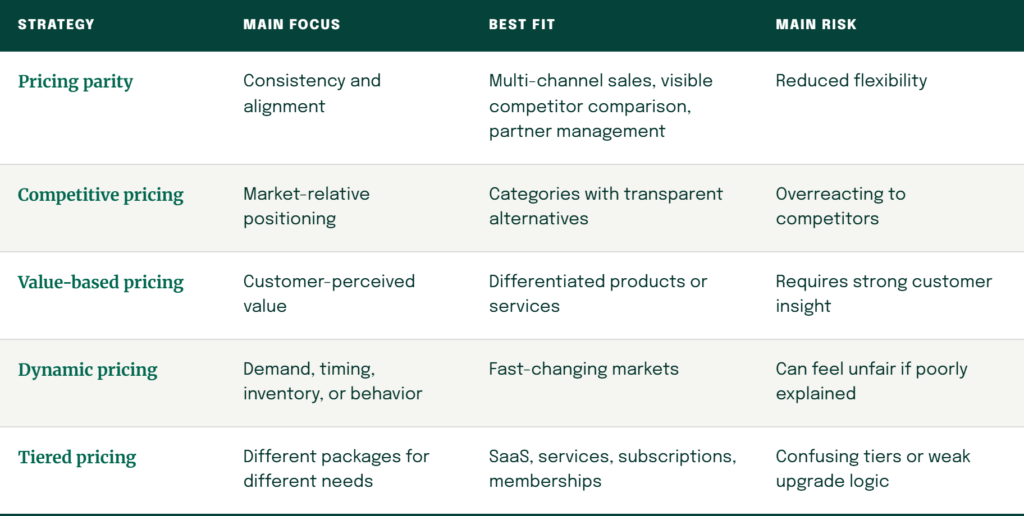
In many businesses, the best answer is a blend. A company may use value-based pricing to set the overall willingness-to-pay range, competitive pricing to stay aware of market expectations, and pricing parity to keep public channel prices aligned.
That layered approach is usually stronger than treating parity as the entire pricing model.
How can businesses implement pricing parity effectively?
Businesses can implement pricing parity effectively by defining clear rules, monitoring prices continuously, assigning ownership, and building a process for exceptions. The policy should explain what must stay aligned, where flexibility is allowed, who approves deviations, and how violations are handled.
A practical rollout often includes these steps:
- Map every active sales channel Include direct ecommerce, marketplaces, distributors, resellers, sales reps, affiliate offers, and regional storefronts.
- Identify parity-sensitive products or offers Not every item needs the same level of control. Focus first on high-visibility products, strategic accounts, flagship services, or offers that trigger partner conflict.
- Define the allowed differences Clarify whether shipping, taxes, loyalty benefits, bundles, financing, service levels, or contract terms may vary while the base price remains aligned.
- Create a documented pricing policy The policy should be understandable to sales, marketing, finance, ecommerce, and channel partners. Avoid vague rules that require constant interpretation.
- Use monitoring and pricing analysis Competitive intelligence tools, marketplace monitoring, repricing platforms, and internal dashboards can help teams spot gaps quickly.
- Build an enforcement workflow Decide what happens when a reseller violates guidelines, a promotion breaks parity, or a competitor moves sharply. The response might include a warning, correction request, pricing review, or legal consultation.
- Review legal requirements by region Parity clauses, resale price controls, and advertised pricing rules can carry different legal implications across markets. Businesses should involve qualified legal counsel before enforcing restrictive policies.
This process turns parity from a loose intention into an operating system.
Practical signs your parity policy needs work
A pricing parity policy should make daily decisions easier. If it creates confusion, it may be too broad, too rigid, or poorly connected to the rest of the pricing strategy.
Watch for these warning signs:
- Sales teams frequently request one-off discounts to “fix” channel price gaps.
- Customers contact support asking why prices differ between platforms.
- Partners complain that another reseller or marketplace has an unfair advantage.
- Promotional campaigns unintentionally violate internal price rules.
- Competitor matching happens automatically, even when margins become unattractive.
- Regional teams ignore central pricing because local realities are not reflected.
- Finance, ecommerce, and sales use different definitions of the “official” price.
These problems do not always mean parity is wrong. They usually mean the business needs better governance, cleaner data, and a clearer distinction between necessary consistency and useful flexibility.
Parity works best inside a broader pricing optimization process
Pricing optimization is about finding the best balance between revenue, margin, demand, customer value, and market position. Pricing parity can support that balance, but only when it is guided by data and strategy.
A healthy optimization process should ask:
- Which products require strict price alignment?
- Where can we charge more because our offer delivers more value?
- Which competitors are worth matching, and which are not?
- How much margin are we willing to trade for channel stability?
- What exceptions improve profitability without damaging trust?
- How often should pricing analysis trigger a policy review?
These questions keep parity from becoming passive imitation. They also help teams avoid the common trap of matching the lowest visible price while ignoring the full economics of the sale.
Final takeaway
Pricing parity is most useful when it creates trust, reduces channel conflict, and supports a deliberate market position. It is not a substitute for value-based thinking, customer research, or disciplined pricing analysis.
The best approach is balanced: use parity where consistency matters, use competitive pricing where market visibility matters, and use flexible pricing models where customer value and demand vary. When those pieces work together, price alignment becomes a strategic tool rather than a margin-limiting rule.