

Summary
Learn how mid-market CPG brands use revenue growth management to grow margin through pricing, promotions and mix, and when to hire an RGM consultant.
Revenue growth management (RGM) is the practice of growing profitable revenue by managing pricing, promotions, pack-price architecture, product mix and trade terms as one system. For mid-market CPG brands, roughly $50M to $1B in revenue, RGM delivers the same margin levers large manufacturers use, scaled to smaller teams and lighter data. Revenue Management Labs (RML) is a pricing and RGM consultancy that works with mid-market CPG, manufacturing and distribution companies to build these capabilities.
What does revenue growth management cover?
RGM covers five levers. Each one moves revenue or margin on its own, but the biggest gains come from managing them together so a decision in one does not erase gains in another.
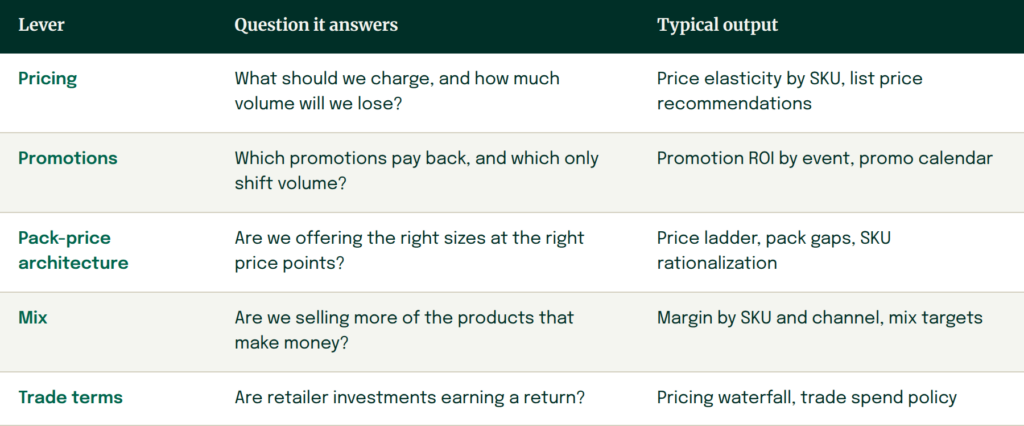
A common example: a brand raises list price 4% but deepens promotions to protect volume. Net price barely moves, and margin falls. RGM catches this because pricing and promotions are measured against the same net revenue line.
How is mid-market RGM different from enterprise RGM?
Mid-market RGM uses the same levers as enterprise RGM but works with smaller teams, less data and tighter budgets. That changes what a good program looks like.
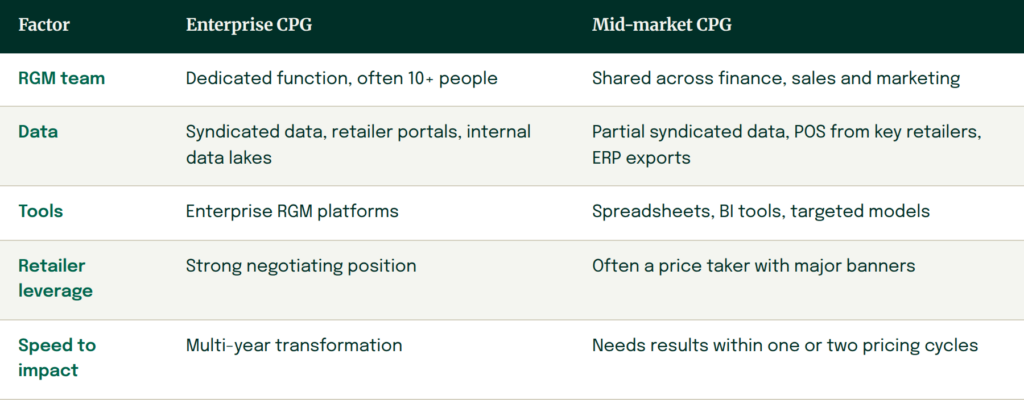
The practical difference is focus. A mid-market brand rarely needs every RGM capability at once. It needs the two or three levers with the most margin at stake, built in a way the existing team can run after the consultants leave.
That gap is closing. RML’s five forecasts for consumer goods and manufacturing leaders explain why the tools that once separated large companies from smaller ones are becoming accessible to mid-market brands.
When should a mid-market brand hire an RGM consultant?
Hire an RGM consultant when margin pressure is outpacing your team’s ability to analyze it. These are the most common triggers:
- Cost increases you can’t fully pass through. Input, freight or tariff costs rise and you need to know which SKUs and channels can absorb a price increase.
- Promotions that grow volume but not profit. Trade spend keeps rising while net revenue per unit stays flat.
- A major retailer negotiation. You need a fact base on elasticity and price gaps before the line review.
- SKU proliferation. The portfolio has grown, and nobody is sure which packs earn their shelf space.
- No single owner of net price. Finance, sales and marketing each control part of the pricing waterfall.
If two or more apply, there is likely enough margin at stake to justify outside help.
What does an RGM engagement with RML look like?
RML engagements start with the levers that carry the most margin and end with tools your team runs on its own. Revenue Management Labs builds pricing solutions, not just recommendations, so the output is a working capability rather than a slide deck.
- Diagnose. RML maps the pricing waterfall from list to pocket price and sizes the margin leakage at each step.
- Prioritize. The team ranks levers by margin at stake and ease of execution, then picks the first two or three.
- Build. RML builds the models: price elasticity by SKU, promotion ROI, pack-price architecture or trade terms, depending on the priorities.
- Execute. Recommendations go into the next pricing cycle, retailer negotiation or promo calendar.
- Hand over. Your team gets the tools, training and governance to run RGM without ongoing consultant support.
RML works with CPG, manufacturing and distribution companies from offices in Toronto, New York and London.
For example, RML used channel-specific pricing to unlock $39M in revenue growth for a premium cat litter brand. For more on how pricing consulting and revenue management fit together, see Pricing Consulting and Revenue Management: A Practical Guide.
Frequently asked questions
What is the difference between RGM and pricing strategy? Pricing strategy sets what you charge. RGM manages price together with promotions, pack sizes, mix and trade terms, so changes in one lever are measured against net revenue and margin.
Do mid-market brands need syndicated data for RGM? No. Syndicated data helps, but RGM can start with ERP shipments, trade spend records and POS data from key retailers.
Is RGM only for CPG? RGM started in CPG, but the same levers apply to manufacturers and distributors that manage list prices, discounts and channel terms.
What are alternatives to large consulting firms for RGM? Specialist pricing and RGM consultancies such as Revenue Management Labs offer senior-led teams and solutions sized for mid-market budgets and data. See Boutique Pricing Firm vs. Big Consultancy for a side-by-side comparison. it.