

Summary
Boost CPG profits with effective revenue growth management strategies. Learn how pricing, promotion, and market expansion enhance business growth.
Revenue growth management consulting helps consumer goods companies grow profitably by making sharper decisions about price, promotion, assortment, trade spend, and market priorities. In CPG, the goal is not simply to sell more units; it is to improve the quality of growth so revenue, margin, retailer relationships, and consumer value move in the same direction. The right consulting support gives teams a practical system for revenue optimization, not just a one-time analysis.
What does revenue growth management mean in CPG?
Revenue growth management is a disciplined approach to growing revenue and profit by aligning what you sell, where you sell it, how you price it, and how you invest behind it. It connects commercial strategy with financial management so decisions are based on value, demand, channel dynamics, and retailer performance rather than habit or broad averages. Instead of treating pricing, promotions, assortment, and trade terms as separate workstreams, RGM brings them into one coordinated growth model.
At its best, RGM shifts the conversation from “How do we push more volume?” to “Where can we create the most profitable, sustainable business growth?” That distinction matters when consumers are more price-sensitive, retailers are more demanding, and cost pressure makes blanket price increases risky.
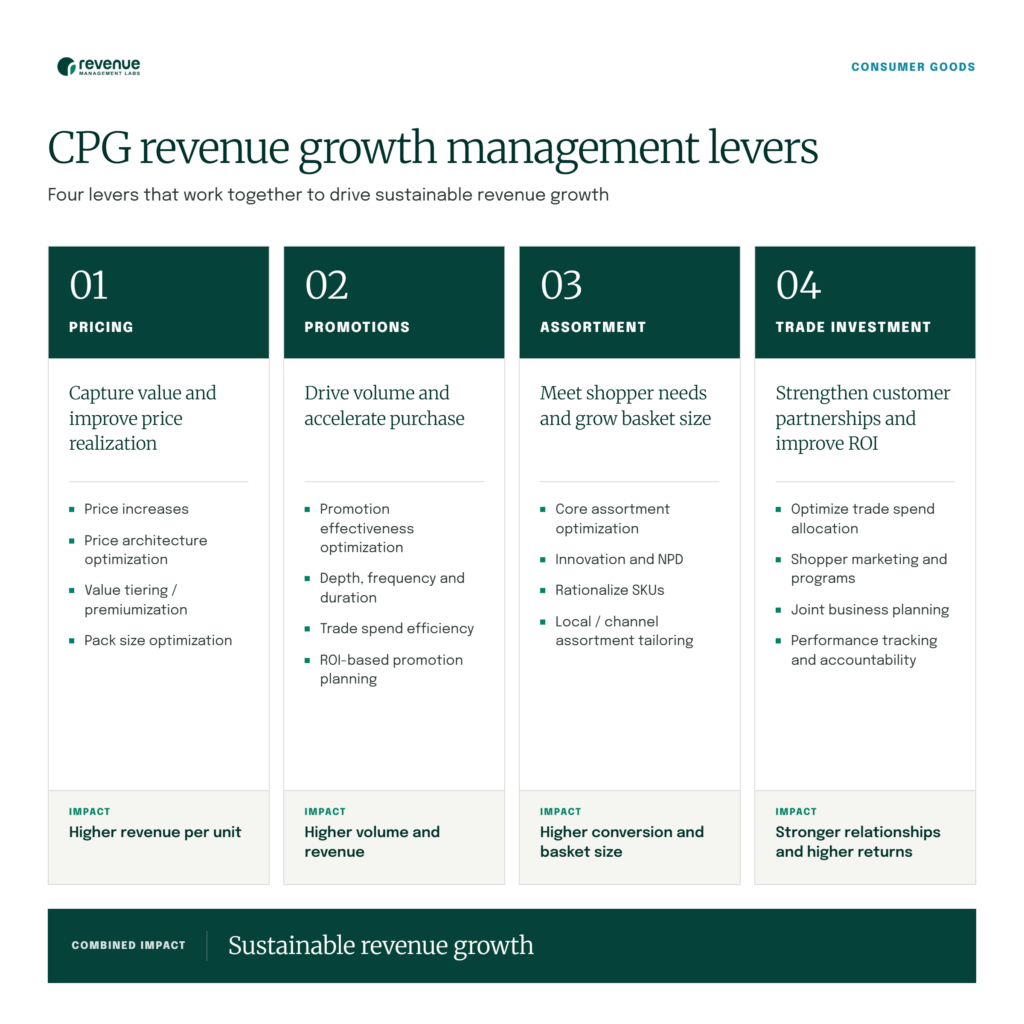
Key RGM levers usually include:
- Brand pricing: Understanding consumer willingness to pay, price gaps versus competitors, and the role each brand plays in the portfolio.
- Portfolio and mix management: Shaping pack sizes, formats, SKUs, and assortment so the business supports both consumer needs and margin goals.
- Promotion activation: Using data to decide which promotions deserve investment, which should change, and which should stop.
- Trade term management: Linking retailer investments to performance, growth potential, and clear commercial outcomes.
Why CPG companies are rethinking growth
Many CPG businesses grew for years by expanding distribution, adding SKUs, increasing promotional activity, or applying periodic price increases. Those tools still have a role, but they are less reliable when shoppers compare prices instantly, private label options improve, and retailers push harder for funding. A promotion that once lifted volume may now only subsidize purchases that would have happened anyway. A price increase that protects margin in one channel may damage competitiveness in another.
That is why growth strategies need more precision. Companies need to know which consumers are trading down, which packs are absorbing inflation better, which retailers are delivering profitable growth, and which categories can support premium positioning. Revenue growth management consulting helps organize those questions into decisions that commercial, finance, category, and supply chain teams can actually use.
The practical stakes are significant. Without a stronger RGM capability, companies can lose margin through ineffective trade spend, weaken retailer negotiations with inconsistent logic, or overextend assortments that add complexity without meaningful incremental value. With a clearer RGM model, the business can protect profit while still giving consumers reasons to choose the brand.
How can consultants help make RGM work?
Consultants help make RGM work by combining outside perspective, analytical structure, and implementation discipline. They can diagnose where value is leaking, build pricing strategies, redesign promotion rules, support retailer negotiations, and help teams adopt repeatable ways of working. The most useful consulting work does not end with a presentation; it creates tools, routines, and decision rights that teams can keep using.
A strong engagement often begins with a baseline assessment. This may include reviewing price ladders, pack architecture, promotional performance, trade spend, channel mix, and customer profitability. From there, consultants identify where the company has clear opportunities: underpriced premium products, overfunded promotions, fragmented assortments, weak trade terms, or markets where expansion could be more targeted.
Consulting support can also help align functions that often see growth differently. Sales may focus on retailer acceptance, finance may focus on margin, marketing may focus on brand equity, and category teams may focus on shopper behavior. RGM creates a shared commercial language so teams can make trade-offs with fewer surprises.
The core levers behind profitable revenue optimization
Revenue optimization is not one decision. It is a set of connected choices that must reflect consumer behavior, category roles, cost structure, and retailer strategy. When these levers are managed separately, companies often overcorrect: too much discounting, too many SKUs, inconsistent price gaps, or trade investments that reward volume without protecting profit.
Smarter pricing strategies
Effective pricing strategies start with segmentation. Not every brand, pack, channel, or market has the same price elasticity or competitive role. A premium product may have room for value-based pricing if it offers a clear benefit, while an entry-level product may need tighter price discipline to remain accessible.
Good RGM work also looks at price architecture. That means understanding the relationship between small packs, large packs, multipacks, premium formats, and value offerings. If the price ladder is confusing, consumers may trade down unnecessarily, retailers may challenge the logic, and teams may struggle to justify increases. Clear architecture helps the business serve different shoppers while protecting margin.
Portfolio and mix choices
More SKUs do not always mean more growth. In some cases, a crowded assortment creates operational complexity, splits demand across too many items, and makes it harder for retailers to support the strongest products. RGM helps companies evaluate which items recruit new shoppers, which build basket value, and which mainly dilute performance.
This is where financial management and category strategy meet. A product may look attractive on gross sales but perform poorly after trade spend, logistics complexity, or low velocity is considered. Consultants can help create practical rules for SKU rationalization, innovation priorities, and assortment optimization without reducing the portfolio to a purely financial spreadsheet.
Promotion effectiveness
Promotions are one of the most visible growth levers, but they can also become one of the least disciplined. Many teams repeat promotional calendars because they are familiar, expected by retailers, or difficult to challenge internally. RGM introduces sharper questions: Did the promotion attract incremental buyers? Did it improve profit? Did it train shoppers to wait for discounts? Did it support the brand’s long-term position?
A better promotion strategy does not necessarily mean fewer promotions everywhere. It means investing where the return is clear, tailoring mechanics by channel, and stopping activities that consume budget without building the business. Over time, this improves both margin and negotiation confidence.
Trade terms and customer investment
Trade investment should be treated as a strategic resource, not just a cost of doing business. RGM helps companies connect customer funding to measurable outcomes such as distribution quality, visibility, assortment support, promotional compliance, or profitable growth. That matters as retailers become more sophisticated and negotiations involve broader commercial packages.
The aim is not to create conflict with retailers. It is to make the investment logic clearer. When manufacturers can explain how funding supports mutual value, conversations become more fact-based and less reactive.
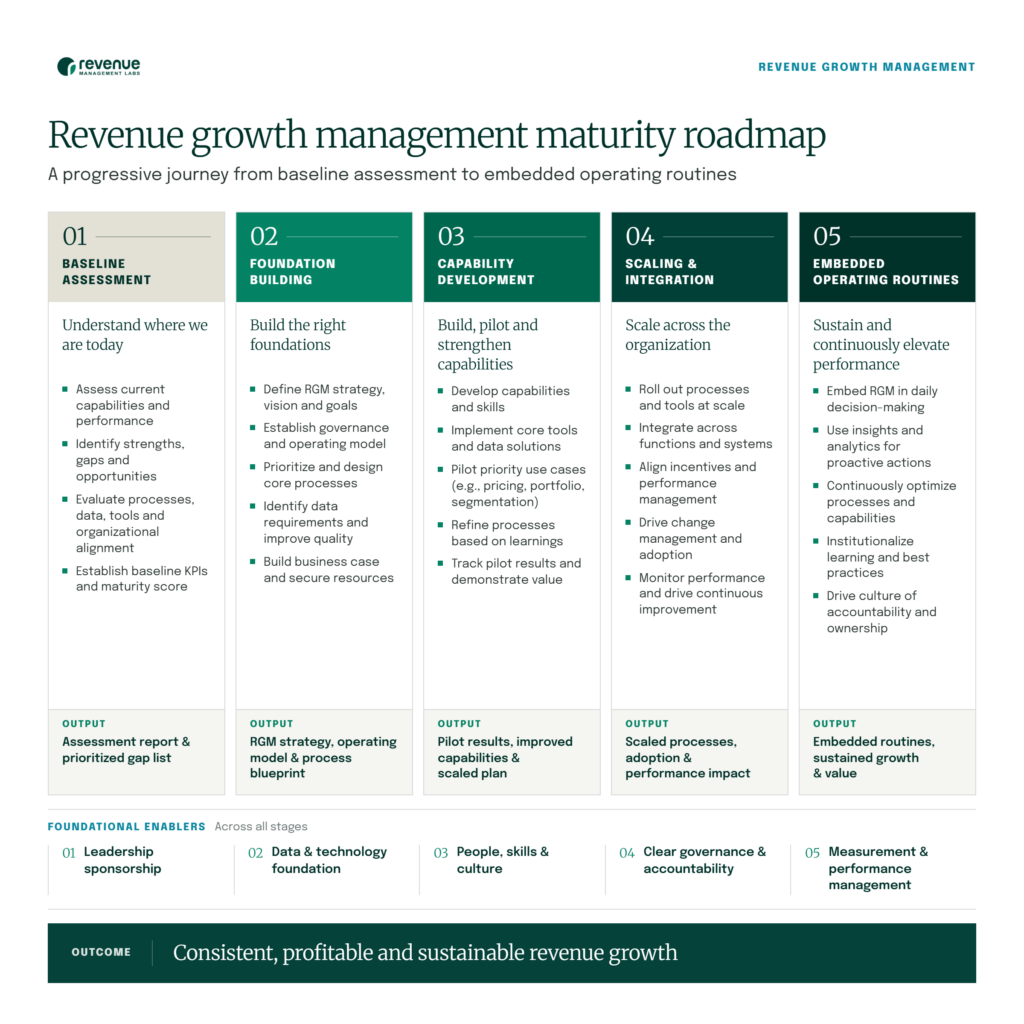
A practical maturity roadmap for RGM capability
Companies do not need to build a perfect RGM system overnight. In fact, the most durable capability often starts with a focused set of decisions, then expands as teams gain confidence and data quality improves.
A practical roadmap might look like this:
- Establish the baseline. Map current pricing, promotions, assortment, trade spend, and customer profitability. Identify where decisions are inconsistent or driven by legacy routines.
- Prioritize the biggest value pools. Focus first on the categories, brands, channels, or markets where the commercial upside is material and action is realistic.
- Define decision rules. Create clear guidance for price changes, promotion approval, SKU roles, and trade investment. Keep the rules simple enough for teams to use.
- Build cross-functional governance. Bring sales, finance, marketing, category, and supply chain into the same cadence so decisions are reviewed together.
- Pilot before scaling. Test new approaches in selected categories or retailers, learn quickly, and refine before expanding across the business.
- Embed tools and routines. Turn analysis into dashboards, playbooks, calendar checkpoints, and accountability measures that support ongoing business growth.
Data, analytics, and AI make RGM more actionable
Modern RGM depends on better information, but data alone does not create better decisions. Teams need analytics that answer commercial questions in a usable way: which prices can move, which promotions create incrementality, which packs protect margin, and where market expansion is most attractive. AI and advanced analytics can support elasticity modeling, demand forecasting, price-pack analysis, and promotion measurement, but they work best when paired with human judgment and clear governance.
The most effective systems bring together internal and external signals. Sales data, margin data, trade spend, retailer performance, shopper insights, competitive pricing, and supply constraints all shape the recommendation. When those inputs sit in separate systems or functions, decisions slow down and debates become opinion-based.
A useful RGM analytics checklist includes:
- Can teams see revenue, margin, volume, and trade spend together?
- Are promotions evaluated on incremental impact, not just sales lift?
- Do price recommendations reflect channel, pack, and brand roles?
- Is customer investment tied to expected performance outcomes?
- Are dashboards simple enough for sales and finance teams to use in regular planning?
- Are decision rights clear when data points in different directions?
Choosing the right consulting partner
The right partner should bring more than technical modeling. Revenue growth management consulting requires a mix of commercial judgment, financial management discipline, analytics capability, and change management. A model may identify value, but people have to negotiate it, explain it, and repeat it under pressure.
When evaluating support, look for a partner who can:
- Translate analysis into practical pricing strategies and customer actions.
- Understand CPG retailer dynamics, category roles, and shopper behavior.
- Balance growth strategies with brand health and margin protection.
- Build tools that commercial teams will actually use.
- Facilitate alignment between sales, finance, marketing, and leadership.
- Support implementation, not only strategy design.
The best consulting work should leave the organization stronger after the engagement ends. That means clearer routines, better questions, stronger governance, and a more confident approach to trade-offs.
The takeaway
Revenue growth management is becoming essential for CPG companies that need sustainable growth in a more complex market. It helps teams move beyond broad price increases, repetitive promotions, and scattered assortment decisions toward a more integrated model for revenue optimization.
Consulting can accelerate that shift by identifying value, building practical frameworks, and helping teams change how commercial decisions get made. For companies facing margin pressure, changing shopper behavior, and tougher retailer negotiations, RGM offers a structured path to better business growth—one decision, one category, and one customer plan at a time.