Summary
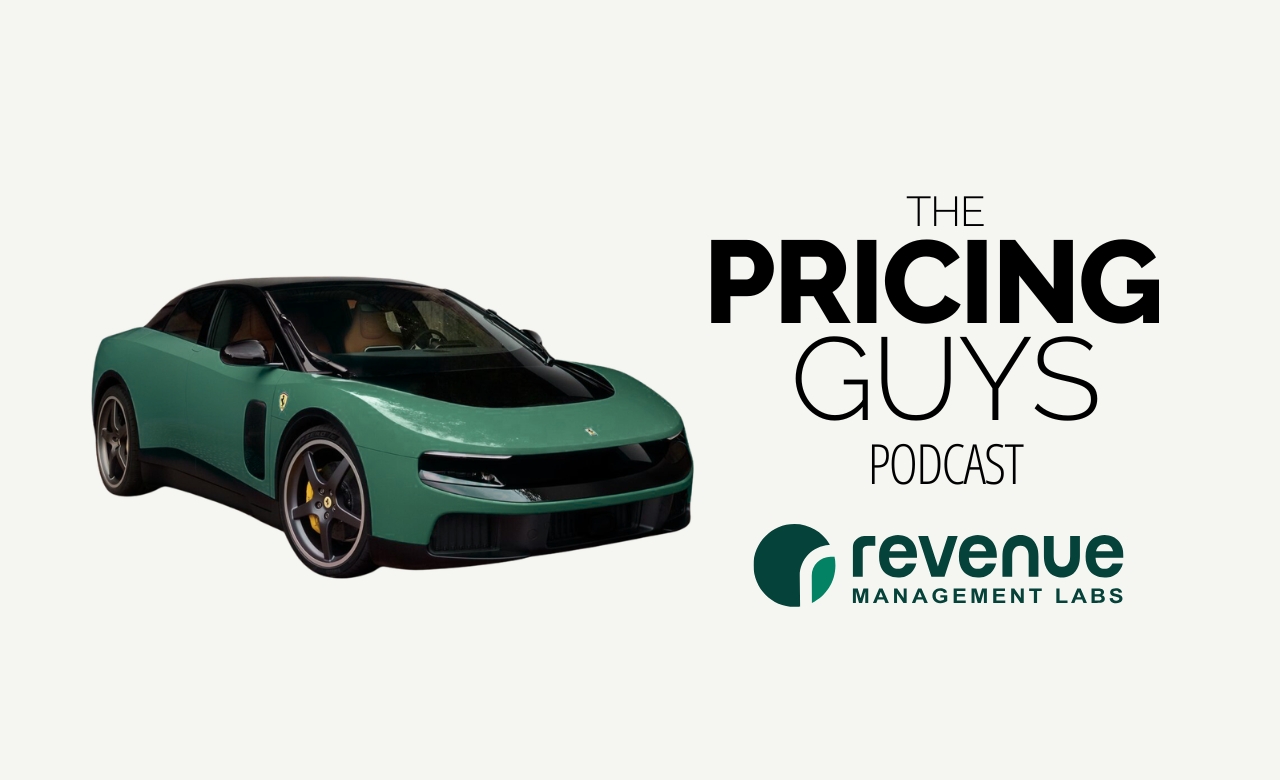
Ferrari’s move into electric vehicles was meant to open the brand to a new kind of buyer. Instead, the company’s stock fell about 8% after the announcement, and production expectations reportedly came down.
The episode looks at what Ferrari’s EV bet teaches us about pricing, innovation, brand equity, and the risk of chasing growth at the expense of loyal customers.
Key takeaways
- Growth plans should start with a clear customer objective: cross-sell, upsell, usage expansion, or acquisition.
- A new product can hurt a premium brand even when its price does not dilute the existing price ladder.
- Innovation is not automatically valuable. It needs to solve a real customer problem.
- If demand is weak, protecting the brand may matter more than keeping a factory running.
- Pricing decisions need to account for customer expectations, dealer economics, fixed costs, and long-term brand value.
Ferrari’s EV challenge is more than a product launch
Ferrari’s electric vehicle, reportedly priced in the range of $640,000 to more than $700,000, sits close to the company’s existing high-end models. That suggests Ferrari was not trying to create a cheaper entry point or a clear value alternative.
The bigger question is: Who is this product for?
A Ferrari is rarely a practical purchase. Customers are buying performance, sound, identity, status, and the experience of owning the car. Fuel costs are probably not a major concern. Neither is maximizing daily transportation efficiency.
That does not mean Ferrari customers cannot care about sustainability. It does mean an electric Ferrari may not connect with the core reasons many existing buyers choose the brand in the first place.
The likely goal was to reach a new customer segment. But entering a new market creates two risks at once:
- The new audience may not show up.
- Existing customers may feel the brand is becoming something different.
The danger of changing what the brand means
Premium brands are built on meaning, not just features. Ferrari’s value comes partly from scarcity and a very specific image. If the company starts sending a different message, customers may question whether the brand still represents what they want it to represent.
This can happen even when the new product is priced correctly. Ferrari may avoid direct price cannibalization by keeping the EV expensive, but that does not automatically protect brand equity.
A similar issue can occur when a luxury brand moves too far downstream. A lower-priced model may attract new buyers, but it can also make long-time customers see the brand differently. Once that perception changes, it is difficult to reverse.
The same pattern appears outside the auto industry. A consumer may connect strongly with an artist’s original sound, for example, and then feel disconnected when that artist makes a sharp move into a new genre. The new work may be perfectly good. It just may not fit the expectations that built the audience in the first place.
Start with the growth job to be done
Before developing a product, leadership teams need to define what the launch is meant to accomplish. There are several distinct growth strategies, and they should not be treated as interchangeable.
| Growth objective | Basic question | Typical level of difficulty |
|---|---|---|
| Usage expansion | Can current customers buy or use more? | Lowest |
| Cross-sell or upsell | Can current customers buy something else? | Moderate |
| New customer acquisition | Can the company win buyers outside its base? | Highest |
Selling more to existing customers is usually the simplest path. Asking them to buy a new product is harder. Creating something unfamiliar for an entirely new audience is harder still.
That does not mean companies should never pursue new customers. It means the strategy needs to be explicit. What customer insight supports the move? Why will the new audience choose this brand? What happens if the existing base sees the launch as a departure?
Revenue Management Labs approaches these questions by connecting pricing strategy to customer behavior, industry context, and practical execution. AI can help identify patterns in demand and segment behavior, but it does not replace the judgment needed to understand what a brand actually stands for.
Innovation for its own sake is expensive
Many organizations feel pressure to launch something new every year. New SKUs, new features, new packaging, new platforms. The activity can look like progress, but the results often tell a different story.
The episode references a consumer goods review in which a company launched roughly 70 new SKUs over several years. Most were discontinued within five years, and only one became profitable. That successful item was not a radical breakthrough. It was a new flavor of an already strong product.
This is a common pricing and portfolio lesson: the core business often funds experimentation, while the core business itself receives less attention.
Innovation should answer practical questions:
- Is the product solving a meaningful customer need?
- Is the category expandable, or is the launch only replacing an existing purchase?
- Will customers buy more, switch brands, or simply divide their spending?
- Can the company support the product through pricing, sales, operations, and distribution?
A new scent in laundry detergent may encourage switching, but it is unlikely to make a household run twice as many loads. A beer promotion can increase consumption because the category is more expandable. Those are different commercial jobs and require different strategies.
What should Ferrari do if units do not move?
Ferrari faces a difficult operational problem if electric models remain on dealer lots. Dealers carry inventory costs and may eventually discount vehicles to move them. That creates pressure on the entire pricing system.
The first instinct might be to cut the price. For a brand like Ferrari, that could be the wrong move. Discounting may create short-term movement while damaging exclusivity and customer trust.
A more careful response would include:
- Slow or stop production until demand becomes clearer.
- Review the customer proposition, not just the price.
- Separate the EV’s identity from the core Ferrari range where possible.
- Work with dealers on inventory without public discounting.
- Reassess the launch assumptions using actual buyer and market data.
Stopping production can hurt near-term financial results because fixed costs remain. But continuing to produce unwanted units may create a larger problem: excess inventory, dealer frustration, and visible brand weakness.
The boardroom lesson
Ferrari’s EV decision may still become a long-term success. Electric technology will continue to develop, and luxury buyers are not a single, uniform group. The issue is not that Ferrari tried to innovate. The issue is whether the company clearly understood the customer it was trying to win—and the customers it could risk losing.
For any business considering a major launch, the essential questions are simple:
- Is this for our current customers or a new audience?
- What does the product add to the brand?
- Could it weaken the reasons customers buy from us today?
- Are we expanding demand, or just shifting existing demand?
- What will we do if sales fall short?
The strongest pricing strategies are not built around novelty alone. They connect the offer, the customer, the brand, and the economics. That is how companies find growth without quietly giving away the value they already worked hard to create.
Catch all episodes for The Pricing Guys
– YouTube: https://lnkd.in/eKG43AT2
– Spotify: https://lnkd.in/evBnafHv